
Increase conversion rates – through personalization
There are many ways to increase the conversion rate in your online shop. We will show you the options available to you using various live examples.

The conversion rate is one of the most important KPIs for measuring the success and effectiveness of your online marketing activities. If it increases, you have the ideal starting point for winning more customers and generating higher sales. In this article, you will learn which conversions are crucial in e-commerce, which factors influence the conversion rate, and how you can optimize it.

Here'swhatyou can expect to find in this blog article:
Definition: What is a conversion?
Particularly important conversions in e-commerce
Touchpoints that are crucial for conversion success
Definition: What is the conversion rate?
Calculating conversion rate: two simple formulas
What is a good conversion rate for an online store?
5 important factors influencing conversion rates in e-commerce
#1 Content
#2 UX design
#3 Call to action (CTA)
#4 Navigation & page structure
#5 Loading times
10 (+1) ways to increase conversion rates in e-commerce
Conclusion: Conversion rate as a guarantee of success in online shops
Conversion refers to a specific action that online shop visitors are expected to perform, such as making a purchase or subscribing to a newsletter. In addition to such larger conversion goals (macro conversions), there are numerous micro conversions that can also be identified and measured (e.g., viewing a product detail page or shopping cart). They can help to uncover weaknesses in the purchasing process.
Even if your first thought when defining conversion is measuring completed purchases, there are many other conversions that can be tracked, such as:
In e-commerce, there are several touchpoints that are crucial for conversions and therefore require your special attention:
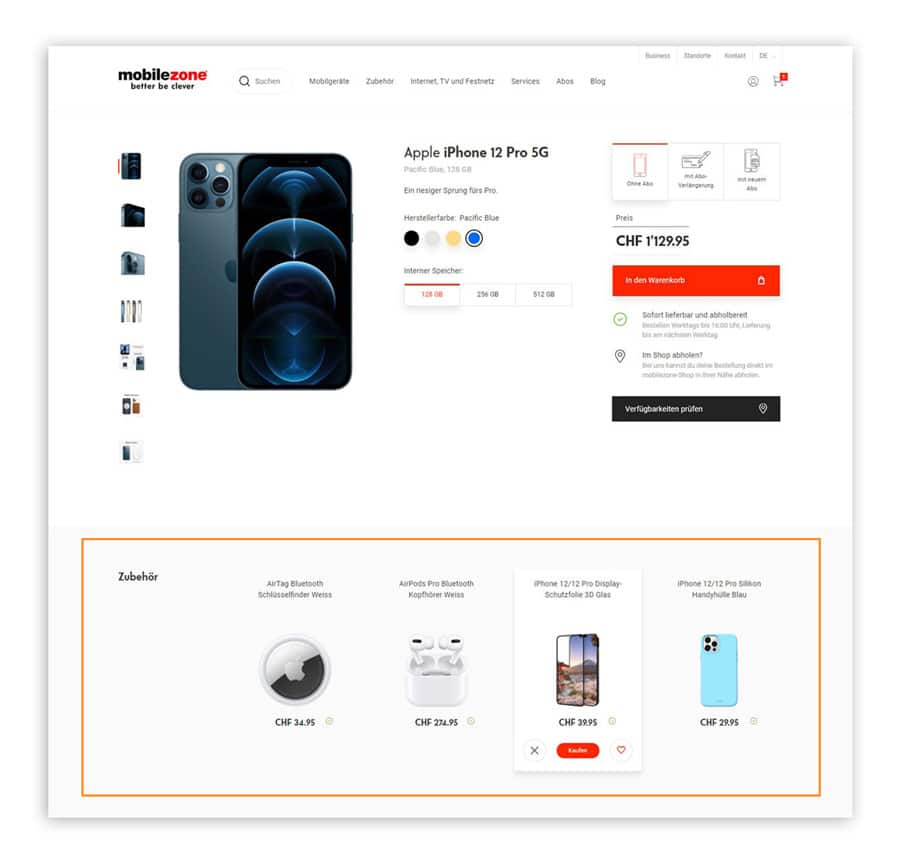
Mobilezone relies on relevant accessory recommendations on the product detail page as an important touchpoint for conversions. (Source: Screenshot from mobilezone.ch)
The conversion rate is one of the most important e-commerce key performance indicators (KPIs). It compares the number of visitors to an online store with the proportion of users who perform the desired action. A conversion rate of 5 percent means that out of every hundred visitors to the online store, five people perform the desired action, e.g., place an order.
Stay up to date on personalization: Sign up for the Epoq newsletter. Register now!
The conversion rate is very important because it reveals weaknesses in the process. If it is consistently high but then drops significantly during the ordering process, you should check whether your checkout process is too complicated or whether there are too few payment methods available.
To calculate the key figure, use this formula:
–> Conversion rate (in %) = Number of conversions : Number of visits x 100
However, this formula has a weakness: it counts all sessions. If users need several visits to the online shop to make their purchase decision, they count multiple times and thus lower your conversion rate. When calculating the conversion rate in e-commerce, it is therefore better to refer to unique visitors. Use this formula for this purpose:
–> Conversion rate (in %) = Number of conversions : Number of unique visitors x 100
As a general rule, the higher the index number, the better your sales opportunities. However, what constitutes a good value depends on many factors. We have listed some of them below:
According to uptain, the average conversion rate for online pharmacies is around 10.4 percent, for fashion 2 percent, and for travel only 0.4 percent.¹ However, a direct comparison of this key figure only makes sense if all parameters are the same, i.e., the same industry, identical target group, corresponding product range, and price level. Since this is rarely the case, a benchmark is neither possible nor meaningful.
Have you ever wondered what motivates your customers to place an order or abandon a purchase during checkout? We'll show you the most important factors that influence your conversion rate.
The content of your online shop, such as category texts and product descriptions, should evoke emotions in visitors, build trust, and encourage them to make a purchase. Ideally, they should present the most important information clearly, provide accurate technical details, and answer any questions readers may have.
If your customers feel well informed, nothing will stand in the way of their purchase. However, if the product description does not tell them how the product feels or what benefits it has, they will leave the online shop due to their negative digital customer experience.
You can find tips for writing compelling product descriptions in our blog article Product descriptions in e-commerce: How to inspire your target audience.
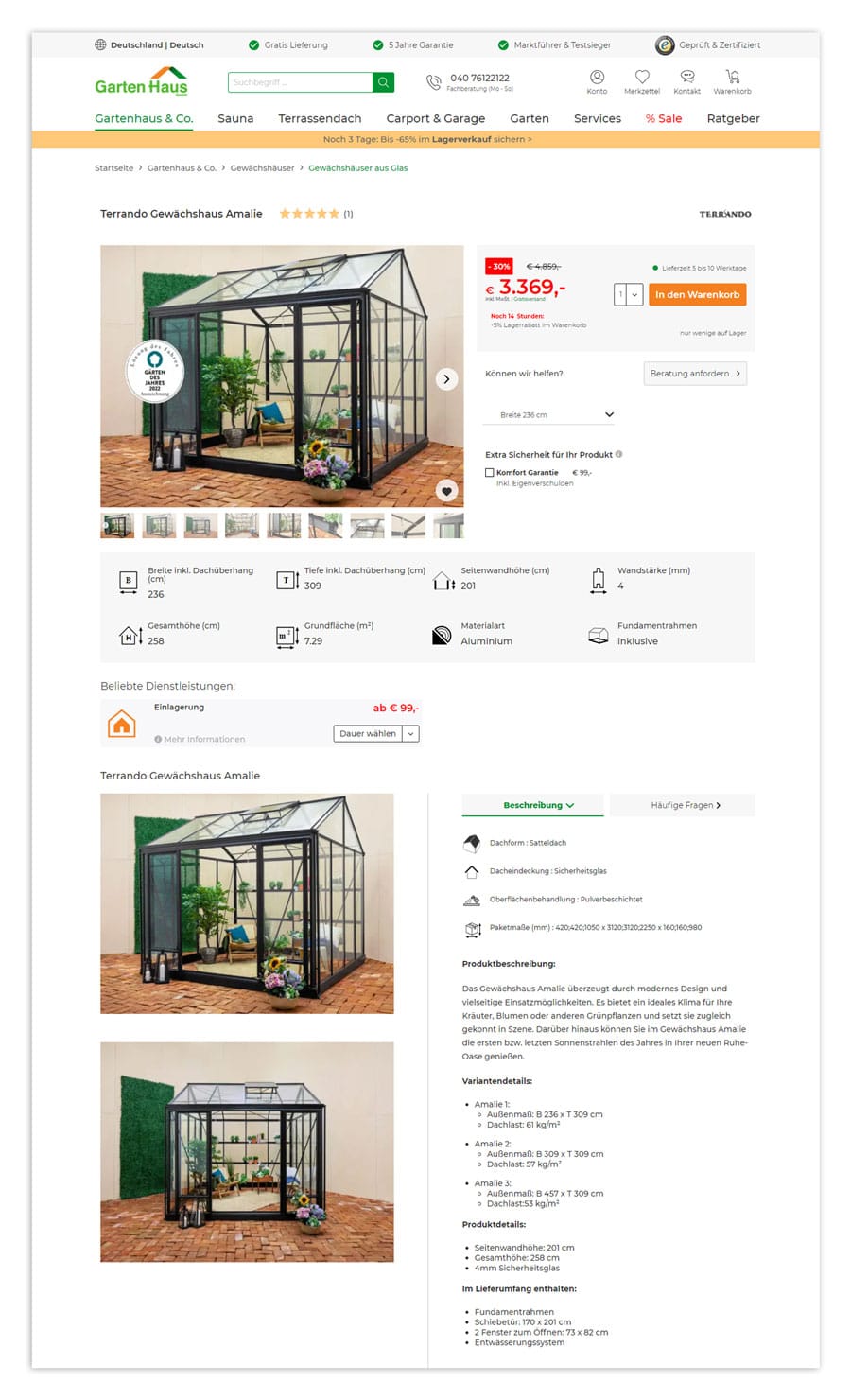
GartenHaus GmbH provides users with the most important product information in a clear format on the PDP and also answers frequently asked questions.
UX can trigger a positive customer experience in e-commerce. After all, user experience is all about evoking emotions in shop visitors and creating incentives to buy. This cannot be achieved with an aesthetic user interface, the right tone of voice, or professional photos alone. Factors such as accessibility from any device, user-friendliness, and the usefulness of a page play an essential role.
If the design looks outdated, the display on smartphones is disastrous, or the page layout looks sloppy, users will quickly switch to the competition.
The way you guide users through your online shop also has a direct impact on the conversion rate. The CTA plays an essential role here with its clear call to action. Cleverly placed CTA buttons with labels such as "Buy now," "Request information now," or "Contact us" show your users what their next step could be. This means they contribute directly to a higher conversion rate.
Stay up to date on personalization: Sign up for the Epoq newsletter. Register now!
Imagine a customer has found the product she wants, wants to add it to her shopping cart, but can't find the button. Her digital customer journey is interrupted, and she is bound to abandon her purchase. The usability, clarity, and navigation structure of a website therefore contribute greatly to the success of a conversion. Non-functioning links, an invisible navigation bar, a lack of optimization for mobile devices, or information that cannot be found, on the other hand, drive up the bounce rate.
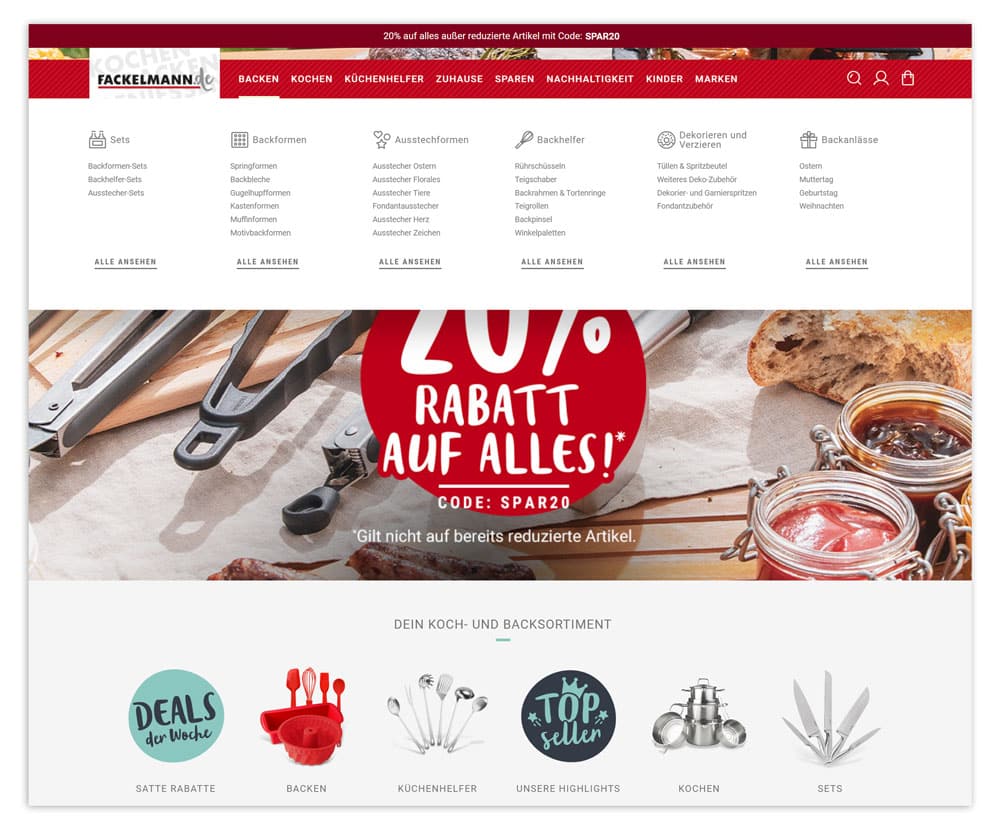
With a clear navigation structure in its online shop, Fackelmann provides a good overview of all categories.
(Source: Screenshot from fackelmann.de)
Google conducted a study to investigate the impact of online store loading times on conversion rates. The results were astonishing: even a loading time of more than one second deters users, as described in an article on onlinehaendler-news.de. After just three seconds, the bounce rate increases by around a third—and after six seconds, it doubles.²
There are a number of ways to optimize conversion rates in e-commerce. This checklist will help you make your business even more successful:
Bonus tip: Personalized customer communication that takes into account the known preferences of regular customers and their previous purchases can act as a booster for the conversion rate. This is because personal one-to-one marketing in e-commerce, personalized product recommendations, or an individually tailored product range increase sales potential. By focusing on 1:1 personalization throughout the entire customer journey, you create holistic shopping experiences in which customers feel individually addressed from start to finish. This ensures that you remain in your customers' minds and strengthens customer loyalty.
When it comes to conversion rates, you should never rest on your laurels. This metric shows you where your online shop still has room for improvement. Just as the market is constantly changing, you should always question successful optimizations and try out new things. You can use modern tools such as A/B testing to find out which version of a subpage converts best. This will help you achieve a continuous improvement process that ensures your long-term success. If you also want to give your online shop a real conversion boost, you can rely on 1:1 personalization along the customer journey to create unique shopping experiences for your customers.
Sources: ¹ uptain, ² Online Retailer News
A conversion is an action performed by customers in the online shop in the desired manner (e.g., a purchase or newsletter subscription).
This important metric compares the number of conversions to the number of page views or unique visitors.
The conversion rate is calculated using these formulas:
Conversion rate (in %) = Number of conversions : Number of visits x 100
Conversion rate (in %) = Number of conversions : Number of unique visitors x 100
There is no general answer to this question. The conversion rate varies not only between different industries, but also between representatives of the same industry due to factors such as the target group, the product range, brand awareness, and pricing.
A personalized shopping experience ensures relevance throughout the entire customer journey. Among other things, it helps store visitors find the product they want more quickly or select suitable accessories, thereby contributing to an increase in the conversion rate.
Would you like to increase the conversion rate in your online shop through personalization?
Then schedule a web demo now!

You are currently viewing placeholder content from HubSpot Embedded Content. To access the actual content, click the button below. Please note that doing so will result in data being shared with third-party providers.
More InformationYou are currently viewing placeholder content from HubSpot. To access the actual content, click the button below. Please note that doing so will result in data being shared with third-party providers.
More InformationYou are currently viewing placeholder content from HubSpot Meetings. To access the actual content, click the button below. Please note that doing so will result in data being shared with third-party providers.
More Information