5.04% increase in sales per session thanks to new personalization strategy at Outletcity Metzingen
Outletcity Metzingen puts its personalization strategy to the test and increases revenue per session by 5.04%.

A room upgrade at your vacation hotel, a better graphics card for your laptop, or the exclusive version of a handbag—these are all opportunities for upselling. If you can sell your customers a higher-quality product than they originally wanted, you will increase sales in your online shop. To do this successfully, you need a strategy. In this article, you will learn how upselling works in detail and which five techniques will make your upselling strategy successful.
Here's what you can expect to find in this blog article:
What is the difference between the upselling and cross-selling strategies?
Examples of upselling in e-commerce
Backpacks
Watches
Room upgrades
Advantages of an upselling strategy in online shops
Disadvantages of an upselling strategy in online shops
The best techniques for your upselling strategy
Sell at the right time
Suggest product upgrades
Offer transparent and reasonable prices
Utilize social proof
Personalize upselling recommendations
Conclusion: The upselling strategy plays an important role in e-commerce.
Frequently asked questions about upselling strategies in e-commerce
Upselling is about selling the customer a higher-value product or the same product with an upgrade. If the customer decides to do so, this increases the shopping cart value and thus your sales.
The terms upselling and cross-selling are often used interchangeably. However, they are two different tactics for increasing sales: With cross-selling, you offer your customers complementary products, such as matching LED lighting or a tool kit for their new bike. A section on the product detail page such as "Customers who bought this product also bought" or "Matches this" often shows shop visitors suitable cross-selling suggestions.
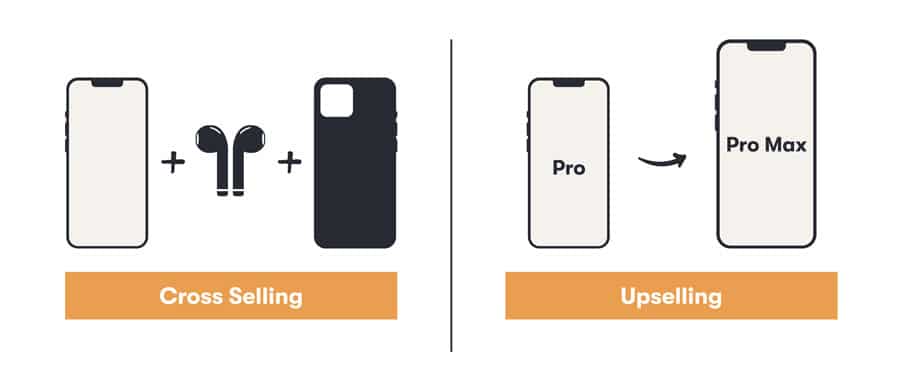
While cross-selling involves recommending complementary products in the form of matching accessories such as headphones or smartphone cases,
upselling involves offering a higher-value product such as the "Pro Max" version of a smartphone.
Stay up to date on personalization: Sign up for the Epoq newsletter. Register now!
You can find out more about cross-selling in our blog article Cross-selling strategy: How to easily increase your shopping cart value.
We will use a few examples to explain how upselling works in an online store.
Your customer has chosen a hiking backpack with a volume of 30 liters. Using a recommendation system, you suggest a higher-quality product that offers additional storage compartments and better ventilation at the back. These advantages convince the customer to change her original purchase decision.
One of your customers is looking for an elegant watch for her husband. She has found the right model and now has to choose between two straps: a simple black leather strap or a strap made of a particularly high-quality material in an exclusive color. The customer is happy to spend a little more money to make her husband happy.
Customers can book a trip in your online shop. The "14-day summer vacation in Istria" package includes a standard room. For a reasonable surcharge, customers can upgrade to a higher category room with a larger bed and a balcony.
Upselling is only worthwhile for your online shop if you do it right. Customers who have already decided on a product are easier to convince to buy a higher-value version than prospects who are at an earlier stage of their customer journey. This allows you to maximize the sales potential of your existing customers and potential buyers. This is more cost-effective for you than having to acquire new customers.
With higher-priced products or services, you also appeal to other purchasing motives of your customers. They buy many things to get more attention from those around them. An example: The quality of sports shoes from well-known brands is not necessarily better than that of unknown brands, but the corresponding logo on the product fulfills a need for recognition.
Furthermore, you can increase your margins and earnings with an upselling strategy. Entry-level models are much more price-sensitive than high-end products, which often have tight profit margins. Higher-value goods or services therefore not only generate more revenue, but also more profit.
Finally , upselling increases customer satisfaction. The higher price must first be overcome as a hurdle, but then your customers will enjoy their more expensive product or exclusive service more. They will be happy to shop at your online store again.
Upselling involves implementing a complex strategy in your shop: data must be analyzed, a suitable recommendation strategy developed, and product recommendations integrated into the desired locations in the online shop. However, the extra effort will be worthwhile and will result in higher sales.
If you offer your shop visitors products that they don't need or that are far beyond their budget, this can have a negative effect.There is a risk that you will be perceived as too pushy. The consequence: your shop visitors will abandon the purchase process and look elsewhere for the product they want.
Upselling works particularly well when you know your customers well. This is possible with the help of data you collect about their clicking and purchasing behavior, such as order history, favorite products, and average budget. This data can be used to derive personal preferences, which will help you present tailored offers. This customer data forms the basis for all upselling tactics that you can implement in your online store. In addition, well-maintained product data plays an essential role in pursuing the desired recommendation strategy.
Your customers are at different points in their customer journey. In the sales process, you can therefore engage in upselling before the purchase, on the product detail page, and in some cases even after the purchase.
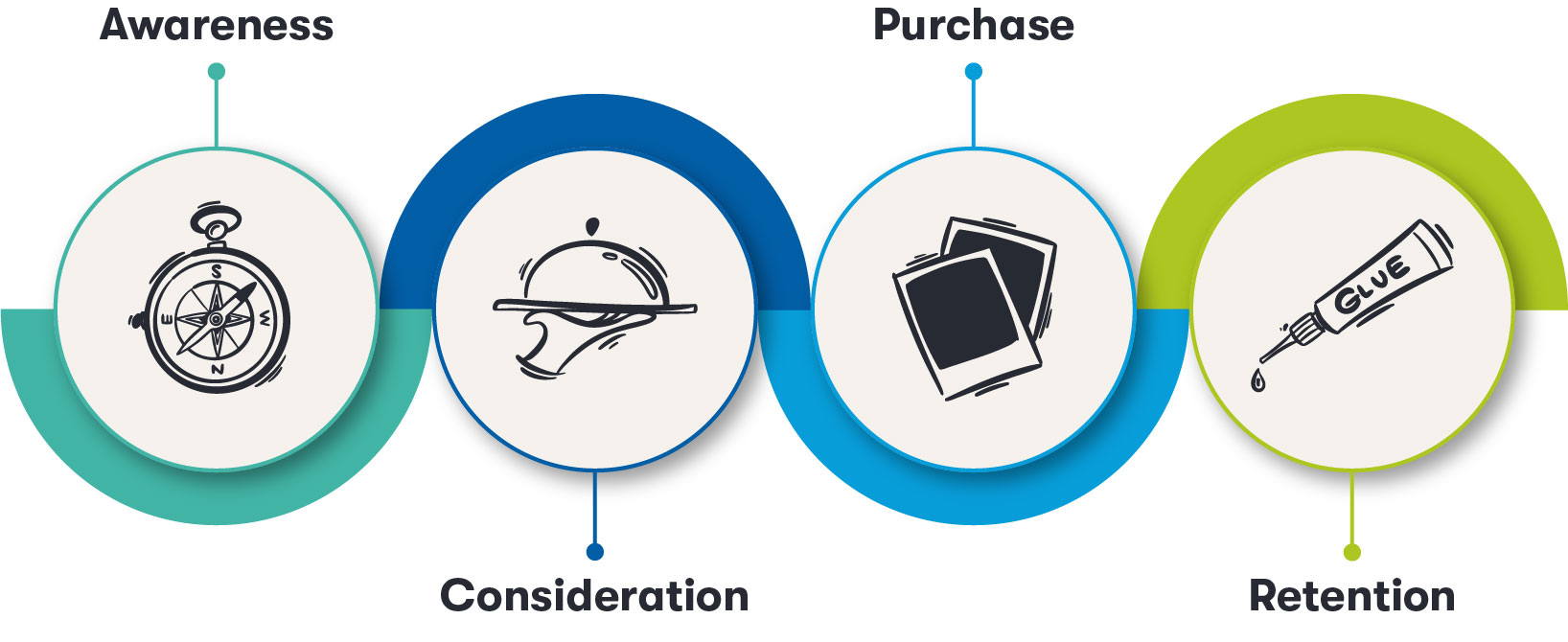
An upselling strategy can be used at various points within the customer journey.
It is particularly suitable for use in the purchase readiness phase.
If your customers have narrowed down their desired products using faceted navigation, for example, show them one or more higher-quality product recommendations at the top of the results. These could be bestsellers or products with lots of positive reviews. You can also take personal preferences into account here and display higher-quality products that match individual preferences and are therefore particularly relevant to your shop customers. These suggestions at the beginning will serve as a reference for shop visitors for all subsequent results, which will then appear cheaper or less valuable in comparison.
Once shop visitors have decided on a particular product, you can offer them additional options on the product detail page. For example, customers can purchase the baby album to design themselves individually or choose a set consisting of the album and matching stickers. The second option offers them added value, as the stickers are not available individually. Another example would be buying a smartphone: here, shop customers can often choose between different options regarding storage capacity on the product detail page.
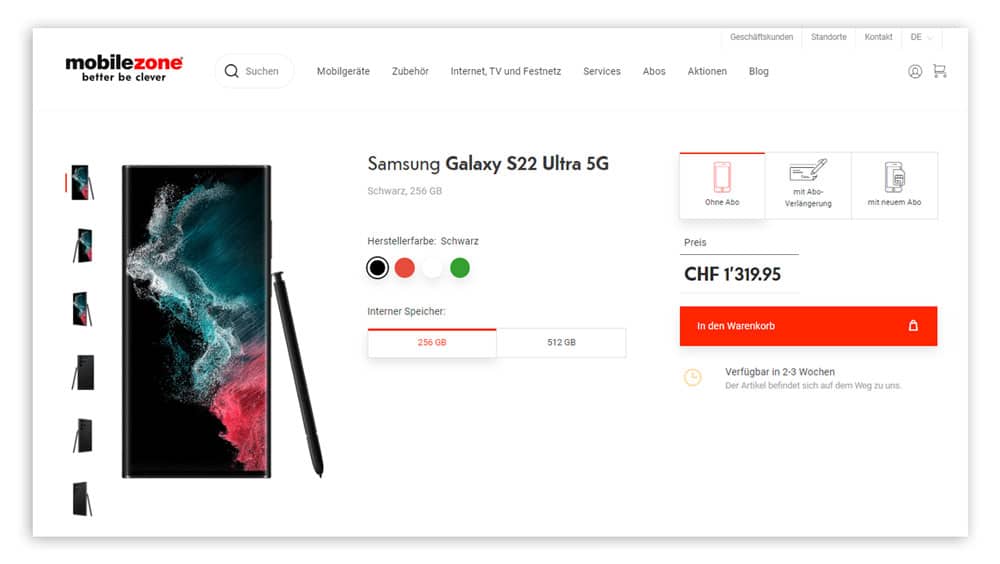
In the mobilezone online shop, customers sometimes have different options to choose from on the product detail page for a smartphone
with regard to internal memory. (Source: Screenshot from mobilezone.ch)
In some cases, upselling is also possible after the purchase, for example, for a booked trip. You can send your customers an email offering them the option to upgrade their flight or hotel room.
Reminder emails are also useful for consumer goods such as cereal, hygiene products, or contact lenses. If your customers repeatedly order the same products from your store, you can use their individual order history to calculate the frequency of use for these types of products in relation to the package size. Shortly before the product is calculated to be running low, you send your customers a personalized email and offer them this product again. With one click, their desired product ends up in the shopping cart. This saves time for customers and generates sales for you.
Product upgrades are another promising technique for your upselling strategy. Perhaps your products can be individually configured. Then your customers can choose the version that best suits their needs. Or you can offer the product in exclusive packaging, such as their favorite coffee in a vintage-style metal tin.
If you sell services in your online shop, you can win over customers with different service packages: Shop visitors are interested in a basic internet plan with a speed of 16 Mbps, and you suggest a premium plan with 100 Mbps.
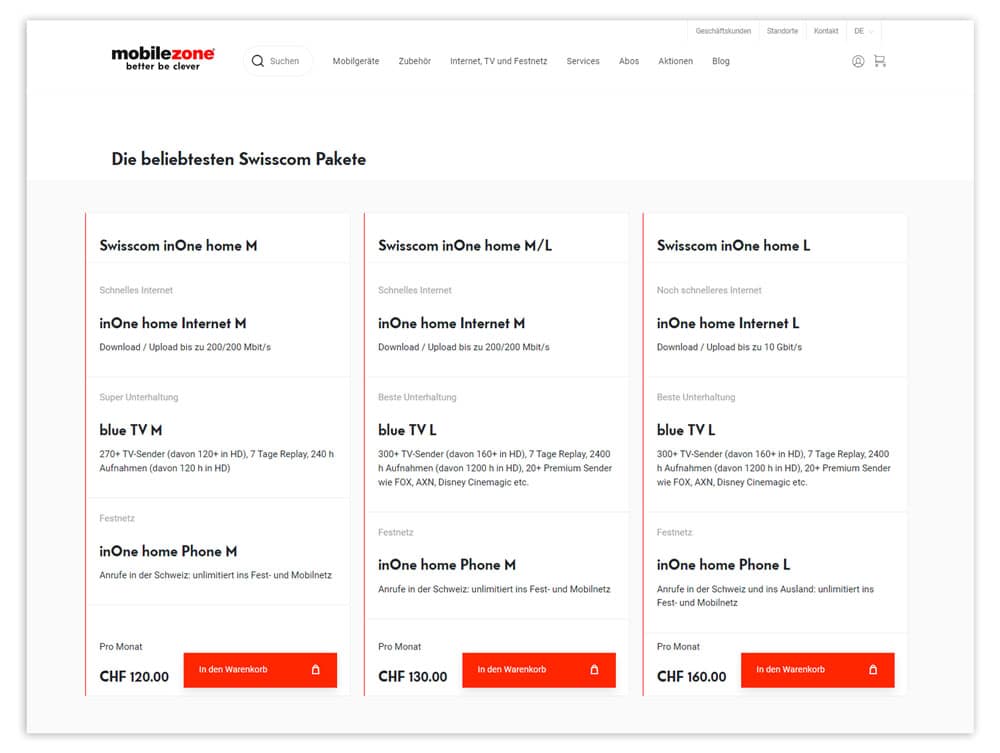
In the mobilezone online shop, customers can choose between different packages with varying service offerings. (Source: Screenshot from mobilezone.ch)
Paid memberships are another option for product upgrades. Customers can purchase a product at the regular price or take out a membership in addition. With the second option, they receive the product at a reduced price or with free shipping, which also applies to future purchases in the same store.
With subscriptions, for example for coffee, wine, or flowers, customers receive their desired product delivered to their home at regular intervals. This is also a form of upselling, as customers are not just buying a single product. It saves them time and generates regular revenue for you.
To encourage your customers to upgrade to a higher-value product, its price should be no more than 20 to 30 percent above the original product price.¹ It makes no sense to offer a customer with a limited budget for a washing machine the luxury model at three times the price. Customers should receive real added value with the more expensive product.
If you offer your customers higher-quality products, it is very important that these products not only meet the original purchase requirements, but alsosuit the individual preferences of each customer (e.g., favorite brand, personal style, preferred material).
Stay up to date on personalization: Sign up for the Epoq newsletter. Register now!
So only show them alternatives that are actually relevant to them and are the right size. You can do this by calculating and displaying tailored recommendations based on your customers' click and purchase behavior, as described at the beginning. If your shop customers recognize the added value on offer, they are more likely to ultimately choose the more expensive product.
With conversion rates averaging 5 percent, every customer who makes a purchase is valuable. Using various upselling strategies, you can increase the shopping cart value of these customers and thus generate more revenue. By using personalized recommendations, you create added value for your customers and increase their satisfaction. This will make them happy to shop at your store again.
Sources: ¹ Daniel Peters, ² HubSpot
Upselling is a sales strategy for increasing revenue. You recommend products to your customers that are of higher value than their original choice. If they accept your recommendation, the shopping cart value increases and so does your revenue.
With an upselling strategy, you can make the most of the sales potential of your existing customers. You address additional purchasing motives of your customers, increase their satisfaction, and boost your profits.
If you are too aggressive with upselling, it can quickly come across as intrusive. There is a risk that your shop visitors will abandon the purchase process and look around for another online shop.
Pay attention to the right timing for product recommendations in the customer journey. Also, use the customer data you have collected to present personalized recommendations. Use honest comments and reviews about your products to convince customers. In addition, offer transparent and reasonable prices for higher-value products or services.
A recommendation system is ideal for displaying upselling recommendations in your shop. To personalize your recommendations, the AI engine links data to knowledge, thereby calculating and displaying relevant recommendations for your shop customers. You can also combine this with other tools such as personalized emails or customer targeting.
5.04% increase in sales per session: Outletcity Metzingen put its personalization strategy to the test.
Request the case study now!

You are currently viewing placeholder content from HubSpot Embedded Content. To access the actual content, click the button below. Please note that doing so will result in data being shared with third-party providers.
More InformationYou are currently viewing placeholder content from HubSpot. To access the actual content, click the button below. Please note that doing so will result in data being shared with third-party providers.
More InformationYou are currently viewing placeholder content from HubSpot Meetings. To access the actual content, click the button below. Please note that doing so will result in data being shared with third-party providers.
More Information
Utilize social proof
Customers trust other customers more than they trust the store itself. That's why honest reviews and comments about products are so valuable in e-commerce. They significantly help your store visitors make purchasing decisions. For example, if they have the choice between a refrigerator with no reviews and one with 1,245 mostly positive reviews, they will most likely buy the second model.