Back to overview
  • Increase Conversion Rate

Agentic Commerce: Why AI Agents Won't Take Over the Entire E-Commerce Industry

  • Published on July 10, 2026
  • Sarah Birk
  • Reading time: 22 min.

AI systems in e-commerce have long since moved beyond simply providing advice; they are increasingly taking over individual steps of the purchasing process. Agentic Commerce has gone from concept to reality in recent months, and with that attention comes the hype: “The traditional online store is dying,” “Personalization is becoming obsolete.” For store owners, this is unsettling and often unhelpful. This article cuts through the hype. It explains where Agentic Commerce really works, what that means specifically for your store, and why personalization is becoming more important—not less important—in this context.

Key Points at a Glance

  • Not all purchases are automated. Routine purchases with clear preferences, in particular, are handled by agents. Inspiration and discovery remain the store's responsibility.
  • Commodity stores and experience-based stores are affected differently. Standardized product lines must be technically compatible. Experience-based stores must enhance relevance and inspiration.
  • Personalization is becoming more important, not less. Agents are aware of specific preferences, and stores use behavioral data to achieve greater relevance and customer loyalty.
  • Technical infrastructure and the shopping experience must be considered together. Product data ensures discoverability, while personalization and inspiration foster customer loyalty.
  • Now is the time to lay the groundwork. Agentic Commerce is rolling out gradually, and those who prepare today will be better positioned tomorrow.

What is Agentic Commerce?

Agentic Commerce describes an approach in whichAI agents independently research, compare, decide, and make purchases on behalf of consumers or businesses, often without direct human intervention at every single step.

A Definition with a Gray Area

The term is not yet used consistently across the board. Some articles already include AI-powered shopping assistants or chat-based advice—that is, systems that lean more toward conversational commerce or guided selling. Others use the term “Agentic Commerce” to refer only to scenarios in which an agent actually acts autonomously and executes transactions.

For the purposes of this article, therefore, a narrower definition makes sense: the term refers here to systems that autonomously handle at least parts of the purchasing process, from research and comparison to execution.

Agentic Commerce vs. Conversational Commerce

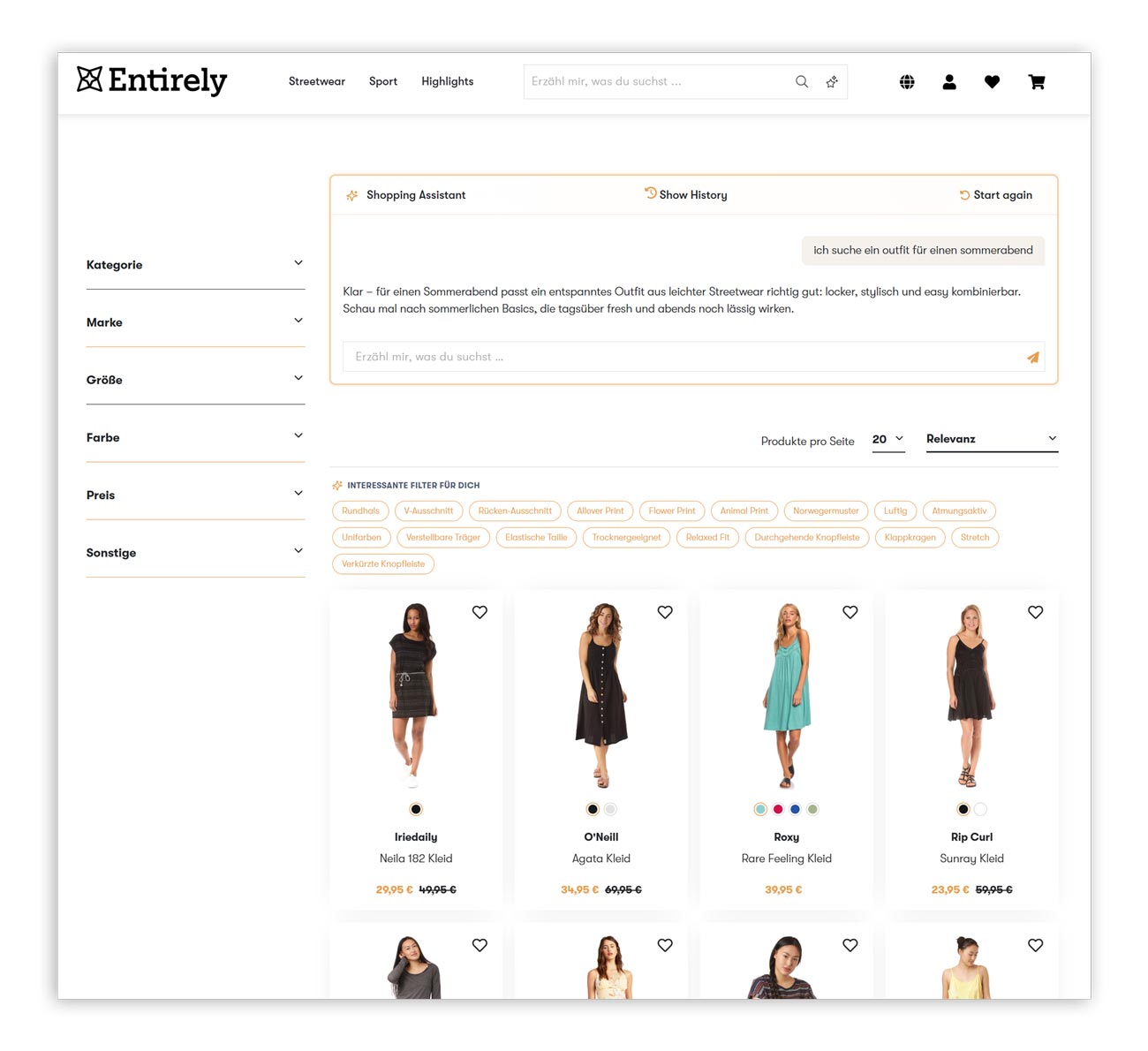
In practice, the lines are blurred. On one hand, there is conversational commerce, in which AI—in the form of an AI shopping assistant —helps with product selection and purchasing decisions, but the human remains actively involved in the purchasing process. On the other hand, there is agentic commerce in the narrower sense—that is, scenarios in which an agent independently researches, makes decisions, and executes transactions. Many current solutions still fall somewhere in between.

An example of a streetwear store featuring an active AI shopping assistant. The assistant responds to the search query “I’m looking for an outfit for a summer evening” and displays matching products as well as tags such as “Flower Print” or “Airy.”

An AI shopping assistant provides conversational guidance, allowing users to actively ask questions and participate in the purchasing process. (Source: Entirely Demo Shop illustration)

This is also evident in many real-world examples currently being discussed under the label “Agentic Commerce.” Often, these examples still focus primarily onAI-powered product search, comparison, and purchase guidance—in other words, conversational commerce or shopping assistance rather than fully autonomous purchasing processes.

What Makes Agent-Based Systems Different

IBM defines AI agents as systems that perform tasks autonomously by designing workflows using available tools. Unlike simple rule-based chatbots, modern agents can reason, plan, and act across systems and platforms

Three features fundamentally distinguish these systems from earlier AI applications in retail: They operate autonomously, meaning they do not require human confirmation at every step. They respond dynamically to changes in their environment, such as when a product suddenly goes out of stock or a competitor lowers its price. And they are interoperable: Through open APIs and standardized interfaces, they can communicate with various systems and platforms without being tied to a single provider.


Stay up to date on personalization: Sign up for the Epoq newsletter. Register now!


What this means in practice can be illustrated with a specific scenario: A user indicates that they need a specific product, and the agent takes it from there. The agent researches offers, checks delivery times, takes current promotions into account, and—if authorized to do so—can complete the purchase directly. The difference from a traditional chatbot or a recommendation system lies not only in speed but also in the ability to take action: The agent doesn’t just make suggestions—they take action.

This is made possible by the interplay of several technologies: large language models (LLMs) for language understanding and decision-making logic, autonomous agent architectures for task control, and open APIs and standardized protocols for system integration.

Where Agentic Commerce Works—and Where It Doesn't

This is the key point that many hype-driven articles overlook. Agentic Commerce doesn't simply work everywhere. The relevant dividing line isn't between "online" and "offline," but rather in how a purchase is experienced and decided upon.

In many current classifications, agentic commerce is defined very broadly and is sometimes described as encompassing the entire customer journey. However, if we look at specific use cases, a clearer picture emerges: agentic behavior is particularly useful in situations where purchases are recurring, standardized, or clearly specified —such as for reorders, price monitoring, or B2B procurement. This is precisely why it is not the entire e-commerce sector that is becoming agentic, but primarily the efficiency-driven parts of it.

A key difference is that agentic commerce is primarily focused on efficiently resolving a specific purchasing need. The emphasis is not on browsing, but on quickly achieving a goal. For many purchases, this is an advantage. For others, however, the opposite is valuable—namely , discovering, comparing, and finding inspiration. And that is precisely where the store remains relevant as a space for experiences.

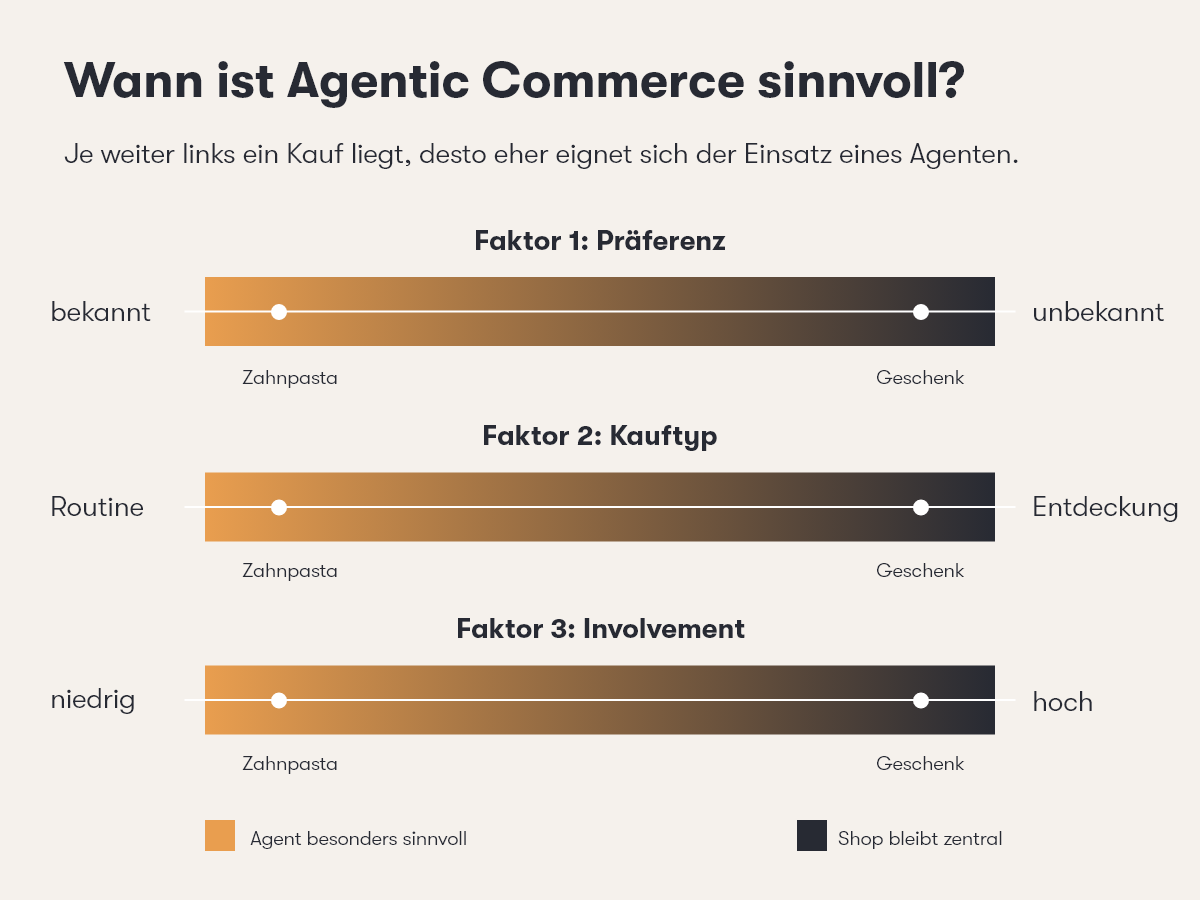
Three factors determine when it makes sense for users to use an AI agent:

Factor 1: Known vs. Unknown Preference

Does anyone always buy the same brand of laundry detergent in the same size? If so, an agent can handle that without thinking. The preference is known, and the decision is trivial.

Is someone looking for a new perfume that fits their changed lifestyle? In that case, their preference is unknown or not at all consistent. Here, the person remains involved in the decision.

Factor 2: Repeat Purchases vs. New Discoveries

Routine purchases such as office supplies, consumables, or dietary supplements are ideal candidates for automation. The added value lies in convenience. Users simply don’t want to handle these types of purchases themselves. This is also reflected in the current discourse: An article on OMR states that AI agents primarily satisfy the need for convenience and time savings, especially when it comes to everyday products and recurring purchases.²

New purchases—where inspiration, comparison, and the discovery of something unknown are part of the experience—cannot be delegated, because the experience itself is part of the value.

Factor 3: Involvement in the Purchase

People often don't want to actively make decisions about low-involvement purchases (commodity products—that is, standardized and interchangeable products—as well as inexpensive consumer goods). Automation is welcome in this context.

High-involvement purchases (fashion, furniture, gifts, lifestyle products) are emotionally charged. Browsing, comparing, discovering—that’s the experience. No agent can replace that experience, because it isn’t a problem that needs to be solved.


An infographic featuring three spectra—preference, purchase type, and involvement—that illustrate when agentic commerce using AI agents is appropriate and when the online store remains the central focus.

The less familiar the preference, the more the purchase is driven by discovery, and the higher the level of involvement, the more important the store remains as a central point of contact (Source: Author's own illustration)


What matters, then, is not whether a purchase is made digitally or in person, but whether it should be handled as efficiently as possible or experienced as a deliberate choice. The more the focus is on preference, repeat purchase potential, and functional benefits, the more appropriate it is to use an agent. The more discovery, inspiration, and emotion shape the purchase, the more important the human shopping experience in the store itself remains.

The key takeaway: Agentic Commerce automates efficiency—not emotion.

Use Cases: Where Agentic Commerce Is a Natural Fit Today

To ensure this doesn't remain just a theory, let's take a look at a few areas where agentic commerce seems particularly plausible today or is already beginning to take shape:

  • Automatic Reordering: Household goods, dietary supplements, printer ink—anything that is used up regularly and doesn't require a new decision. Agents identify the need and place orders based on predefined preferences.
  • Price Monitoring and Automatic Purchase Trigger: The user sets a target price for a product (e.g., a specific electronic device). The agent monitors the market and makes the purchase as soon as the price is reached.
  • Returns and Warranty Claims: Agents handle communication with retailers, initiate returns, and coordinate replacement shipments.
  • Subscription Management: Agents monitor usage patterns, cancel unused services, and optimize plans without requiring the user to take any action.

The examples show that Agentic Commerce is relevant not only for traditional online stores, but also for areas such as subscriptions, travel, and ticketing—in other words, wherever clearly defined, recurring, or process-oriented decisions are made.

What Agentic Commerce Means for Your Store, Specifically

The extent to which Agentic Commerce changes your store depends primarily on one question: “Do my customers shop with me because it’s convenient or because it’s appealing?” The answer to this question determines how much Agentic Commerce will impact your business.

If you're a commodity store

Anyone who sells consumer goods, standardized products, or office supplies faces a structural challenge: In the age of agent-commerce, agents buy from those they know. Large, well-known players with clean product data and open APIs are preferred because agents first find what is structured in a machine-readable format.

Specifically: If your store isn’t “agent-readable”—that is, if it doesn’t offer structured product data or open interfaces—it will become increasingly difficult to be included in agent-supported purchasing processes. Not because the customer doesn’t like you, but because the agent can’t find you.

What’s more, LLMs are currently having the greatest impact on the discovery phase. They help understand user intent and direct users to the right retailers. That’s exactly why clean product data, clear categorization, and technical accessibility are so important. The actual moment of purchase and everything that builds trust—from checkout and loyalty to identity and risk management—remains closely tied to the retailer.

Areas of Focus for Commodity Shops:

  • Structure and Standardize Product Data
  • Enabling API Access for Agents
  • Designing Reorder Processes to Be Suitable for Automation
  • Provide real-time price and availability data

If you're an experience shop

Fashion, lifestyle, home decor, jewelry, gifts—in these areas, agentic commerce has less of an influence on the purchasing process. When it comes to a personal purchase, such as the perfect birthday gift for a best friend, most people want to make the decision themselves.

That doesn’t mean, however, that experiential stores can ignore this shift. Those who use agents to automate more routine purchases will have less time and patience overall for mediocre shopping experiences. On top of that, discovery and selection may increasingly take place through LLMs or AI assistants in the future. In this context, the term “zero-click commerce” comes up time and again. It describes the idea that users are going through fewer and fewer traditional shopping steps on their own. It remains to be seen just how far this will go. One thing is clear, however: even inspired purchases are increasingly starting with a question posed to an AI assistant. Clean product data and technical interoperability therefore remain relevant for experience-driven stores as well. Those who can’t be found there lose potential visitors before they even enter the store.

At the same time, even though discovery may increasingly take place in external interfaces in the future, the online store will not disappear from the customer journey. Recent analyses, such as those by Adyen, show that these systems can serve as an additional channel for retailers to reach users with a high intent to purchase. At the same time, neutral chat interfaces do not automatically evoke the sense of familiarity, guidance, and brand identity that a store or brand website can convey. It is precisely this emotional aspect of the shopping experience that should not be underestimated, and it is a key reason why the store itself remains relevant even in the age of agentic commerce.³ Your own online store remains the place where trust, brand experience, and customer loyalty are built—and while external channels can complement this, they cannot replace it. For you as a retailer, this means above all that your online store must be compelling enough as an experiential space to justify visits—not just as a transactional channel. Personalization and inspiration are becoming more important, not less.

Areas of Focus for Experience Shops:

  • Strengthen the store as an experiential space and build on inspiration, browsing, and digital advice as core strengths
  • Use e-commerce personalization as a differentiator to create relevance at the right moment and build customer loyalty that extends beyond a single purchase
  • Actively Shaping Trust, Brand Identity, and Direct Customer Relationships
  • Ensure discoverability for AI assistants so that LLMs can correctly understand and recommend products

In summary: For commodity shops, the focus is primarily on product data, interfaces, and reorder processes. Experience-driven stores, on the other hand, should invest particularly in personalized search experiences, digital advice, relevant inspiration, and customer loyalty—while building on trust and brand identity as strengths that no external channel can replace. The following applies to both: Clean product data and technical interoperability form the common foundation. The difference lies in priorities and focus.

Commodity Store Adventure Shop
Impact Direct – Agent buys from the most visible provider Indirectly – Customers' attention and patience are waning
Role of the Store Transaction Channel Experience Area
Success Factor Technical Accessibility Inspiration & Emotion
Key Areas of Action Product Data, APIs, Reorder Processes Search, Advice, Inspiration, Customer Loyalty

What Agentic Commerce Means for Personalization in the Online Store

Agentic Commerce does not make personalization obsolete—quite the contrary. The more product search, preselection, and routine purchases become partially automated, the more important the question becomes of where true relevance lies. And this is precisely where your own store remains central.

Agents and shops learn in different ways

Agents also work with preferences, but they learn differently. An external agent knows what a user tells it: “I need laundry detergent, powder, unscented, Brand X.” It knows the explicit specifications and the direct interaction. What it doesn’t see is that the same user adds fabric softener to their cart every time they visit the store but almost never buys it. Or that they regularly browse products in a certain price range without buying anything until a specific trigger occurs.

That’s exactly the difference: An online store learns from a much broader range of behaviors —from clicks, shopping carts, time spent on the site, search queries, repeat purchases, and what wasn’t purchased. This provides a much more nuanced picture of what’s truly relevant to a customer—beyond what they explicitly state.

Personalization in the store remains a key strength

That is precisely why store personalization is not a thing of the past, but rather a distinct advantage. It not only generates more relevant product recommendations —it also provides guidance, accelerates discovery, and makes the shopping experience cohesive and personalized. Especially in situations where people want to browse, compare, and make their own decisions, relevance isn’t achieved through efficiency alone, but through the right timing, context, and a personalized approach.

What the Agent Knows What the Store Sees
Explicit preferences expressed by the user

e.g., “Laundry detergent, powder, unscented, Brand X”

Implicit Preferences: What Customers' Behavior Reveals About Them Without Them Saying It Overtly

e.g., preferred brands, price ranges, materials, colors (as indicated by clicks, purchases, abandoned carts, and repeat purchases)

Relevance not only drives conversions, but also fosters customer loyalty

Personalization doesn’t just have an impact at the moment of purchase. It’s a key tool for bringing customers back to the store—for example, through relevant recommendations, personalized emails, or content that builds on their past interests. Especially as discovery shifts in part to external interfaces, this direct relationship with the customer becomes even more valuable. Those who nurture it have an advantage that no external agent can replicate.

The Challenges of Agentic Commerce

Agentic Commerce brings not only opportunities but also real challenges:

  • Data Protection and the GDPR: Autonomous purchasing decisions made by AI raise serious legal questions: Who is liable if an agent makes a wrong decision? Who has access to the database on which decisions are based? IBM shows that 83% of consumers share concerns about data protection, data misuse, and unsolicited marketing¹—concerns that become particularly relevant in the context of agent-based systems. In the EU, this means that GDPR compliance is not an optional extra but a prerequisite for operation.
  • Loss of control and uncertainty: The more the purchasing process is handled by agents, the less direct contact retailers have with their customers. Brand loyalty, emotions, and spontaneous discoveries are thus partially shifting away from the retailer’s own store. At the same time, users are also relinquishing some control. Not everyone wants to delegate product selection, prioritization, or purchasing decisions to a system—especially when it comes to personal preferences, larger purchases, or sensitive data. That is precisely why transparency, trust, and a sense of control remain key prerequisites for the acceptance of agentic commerce.
  • Platform Dependency: As product searches and preselection increasingly take place via AI assistants and agents, the platforms that provide these access points are gaining influence. For retailers, this means that visibility no longer arises solely within their own stores, but also within the systems that presort, recommend, and redirect products. For small and medium-sized retailers in particular, this raises the question of how they can remain discoverable within these ecosystems without completely relinquishing control over customer access and the brand experience.
  • Data Source:IBM points out that some retailers struggle with fragmented product data that cannot be consolidated across systems.¹ Without clean, structured product data, agentic commerce lacks a central foundation: It becomes significantly more difficult for agents to correctly understand, categorize, and select offers.

How Retailers Can Prepare for Agentic Commerce Now

Agentic Commerce is no longer a distant future scenario, but it’s also no reason to panic. For retailers today, the main priority is to prepare for two things simultaneously: systems that independently find and evaluate products, and shopping experiences in which people still want to actively search, discover, and make decisions. Both areas are relevant for every store—the priority simply shifts depending on the product range and positioning.

Make the store accessible to agents

  • Structuring and Standardizing Product Data: Clean, complete, and semantically rich product data is essential for agents to correctly understand and categorize offers.
  • Check API Accessibility: Anyone who wants to make products accessible to external systems and agents should determine early on whether the product catalog, prices, availability, and shipping terms can be retrieved in a structured format. For commodity shops, the focus is on the transaction level—that is, ensuring that agents can directly access prices, availability, and ordering processes. For experience-based stores, discoverability is key: structured, semantically rich product data and schema markup so that LLMs can correctly understand and recommend products.
  • Thinking Beyond Discoverability: A good Google ranking remains important, but it is not enough on its own. Product information must not only be indexable, but also semantically understandable to AI systems.
  • Building data protection in from the start: Transparency, consent, and GDPR compliance are not secondary considerations in automated purchasing processes—they are prerequisites.
  • Keep an eye on technological developments: Payment providers, commerce platforms, and storefront systems are already building the infrastructure that allows agents to interact securely with product data, shopping carts, and checkout processes.

Enhancing the shopping experience for people

  • Expand personalization: Preferences, behavior, and context remain key to creating relevant experiences in the store and building long-term customer loyalty.
  • Improving Semantic Search: Users and agents are increasingly formulating queries in natural language. A good search engine must understand intent, not just match keywords.
  • Enhancing Digital Assistance in Stores: AI-powered shopping assistants can provide support, make recommendations, and make it easier for customers to discover products in the store.
  • Consciously Designing Inspiration: Especially when it comes to purchases that require greater engagement, browsing remains part of the experience. Stores should actively encourage these moments, rather than simply cutting them short as efficiently as possible.
  • Actively Strengthen Customer Loyalty: To remain relevant in the age of agentic commerce, businesses should focus not only on being discoverable but also on encouraging repeat visits. Personalized emails, content, and product recommendations tailored to a customer’s preferences can create targeted incentives to revisit the store and strengthen the direct relationship with the brand.

Conclusion: Agentic Commerce – Between Automation and the Shopping Experience

Agentic Commerce is transforming e-commerce—but the more interesting question isn’t what agents take over. It’s what they can’t easily replace. It’s hard for an agent to create that feeling of having found exactly the right thing. Brand experiences and genuine customer loyalty don’t emerge from neutral chat interfaces. And what makes a customer come back—not because they have to, but because they want to—can hardly be automated. Right where efficiency ends lies a real source of strength for the store: personalization that not only strikes at the right moment but also builds a relationship. For retailers, therefore, Agentic Commerce is less of a threat and more of an invitation: to define their own strengths more clearly and leverage them more consistently.

Sources: ¹ IBM, 2026, ² OMR, 2025, ³ Adyen, 2026

Frequently Asked Questions About Agentic Commerce

In our e-book on e-commerce personalization, we show how personalization in the online store leads to greater relevance, better navigation, and stronger customer loyalty.

Download now! 

Sarah, Junior Content Marketing Manager at epoq
Sarah Birk
Online Marketing Manager - Content & SEO
Sarah works as Online Marketing Manager – Content & SEO at Epoq and is responsible for the content area. Her responsibilities range from content planning and conception to analysis and optimization of various content formats, taking important SEO aspects into account.