
Increase Shopping Cart Value
In this web demo, we will show you how you can increase the shopping cart value in your online shop using various live examples.

Are your customers shopping in your online store? Great! But is the average shopping cart value rather low and you want to change that? In this article, you will learn why this metric is so important in e-commerce and how you can increase the average shopping cart value of your customers. This will help you increase your sales and profits.

Here'swhatyou can expect to find in this blog article:
What is meant by shopping cart value?
What role does shopping cart value play in e-commerce?
How do you calculate the average shopping cart value?
Average shopping cart value in e-commerce – examples
How can you increase the average shopping cart value?
Free shipping with threshold
Discounts with threshold
Countdown discounts
Loyalty program
Subscription models
Bundles
Personalized offers
Conclusion: A higher average shopping cart value has many advantages.
Frequently asked questions about shopping cart value in e-commerce
The shopping cart value refers to the total value of all products that a customer has purchased as part of an order. The average of this value across all customers and the entire store is also referred to as the average order value.
Alongside the conversion rate, the average order value is an important metric in e-commerce. In combination with other key performance indicators (KPIs), it provides information about how profitable an online shop is. If your average shopping cart value is very low compared to the industry average, for example, you should check why this is the case and take measures to increase this value. This gives you the opportunity to increase your sales and profits.
Stay up to date on personalization: Sign up for the Epoq newsletter. Register now!
Want to know which other KPIs you should be aware of? Then take a look at our article on e-commerce metrics.
The average shopping cart value can be calculated quite simply: your sales within a certain period divided by the number of orders completed during that period. Another option is to calculate the arithmetic mean of the shopping carts for all orders.
However, to obtain a reliable, unadulterated shopping cart value, you should deduct some components beforehand. This primarily includes sales tax. If your customers pay the shipping costs, you can also deduct this amount from the shopping cart. However, if this is not the case, these fees should remain part of the key figure. This is the only way to determine whether you are covering your costs.
You should also include returns in the calculation of the shopping cart value. In the fashion sector in particular, shopping carts are extensive, but the return rate is between 70 and 80 percent. If these are not taken into account, the results may be distorted. The same applies to credit notes that are used in the checkout process.
There is no universal average value for the shopping cart in e-commerce. Rather, this figure depends on the target group of your online shop and the industry in which you operate. High-priced products such as luxury goods, travel, or furniture lead the statistics shown below. According to the intelliAd E-Commerce Industry Index Q1/2018, the average shopping cart value per online purchase for travel was €1,450, for electronics €161, for beauty & fitness around €52, and for books €23.¹ These figures have certainly shifted somewhat as a result of the coronavirus pandemic.
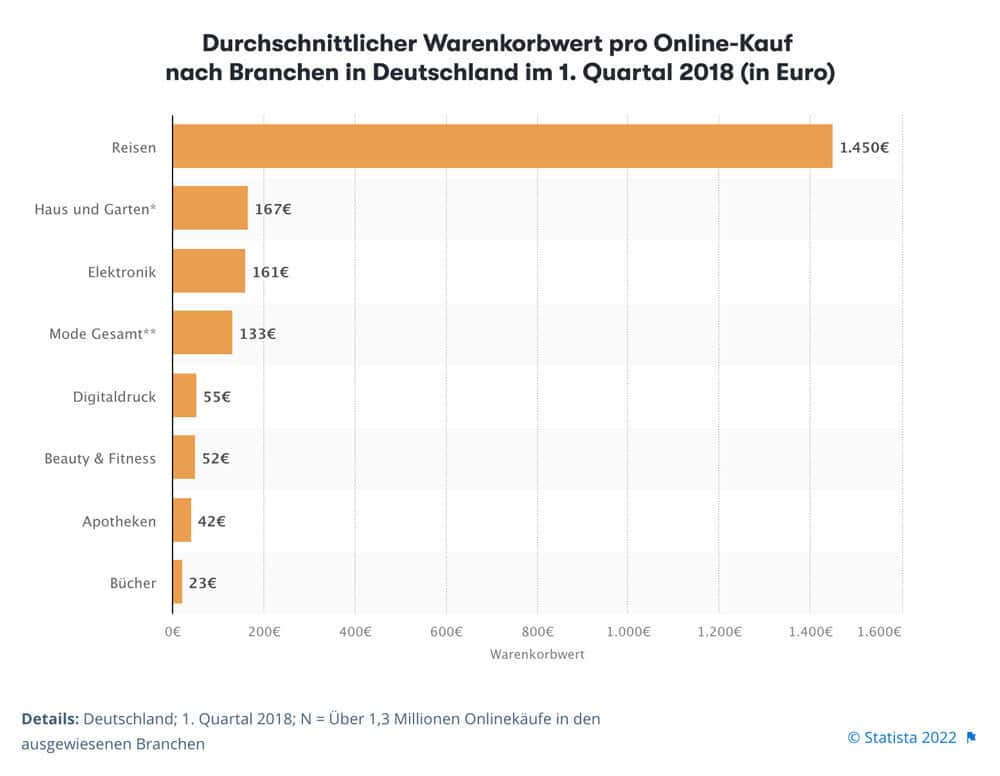
The average shopping cart value can vary depending on the industry. (Source: Screenshot from Statista, survey by intelliAd)
A higher average shopping cart value inevitably leads to more sales. But how do you get your customers to fill their virtual shopping carts? Let's take a closer look at a few possibilities below:
Offer your customers free shipping on orders above a certain value. Various studies have shown that shop visitors greatly appreciate this service: 44 percent of them abandon their order process when faced with high shipping costs. In contrast, 73 percent of customers want free shipping as a checkout option. And 93 percent would even buy more products if delivery were free.²
To maintain your profit margin, you can link free shipping to a specific threshold. Shop visitors tend to add additional products to their shopping cart to reach this threshold. This value can be set just above your average order value, for example.
You can find more tips and strategies for shopping cart optimization in our blog article on this topic.
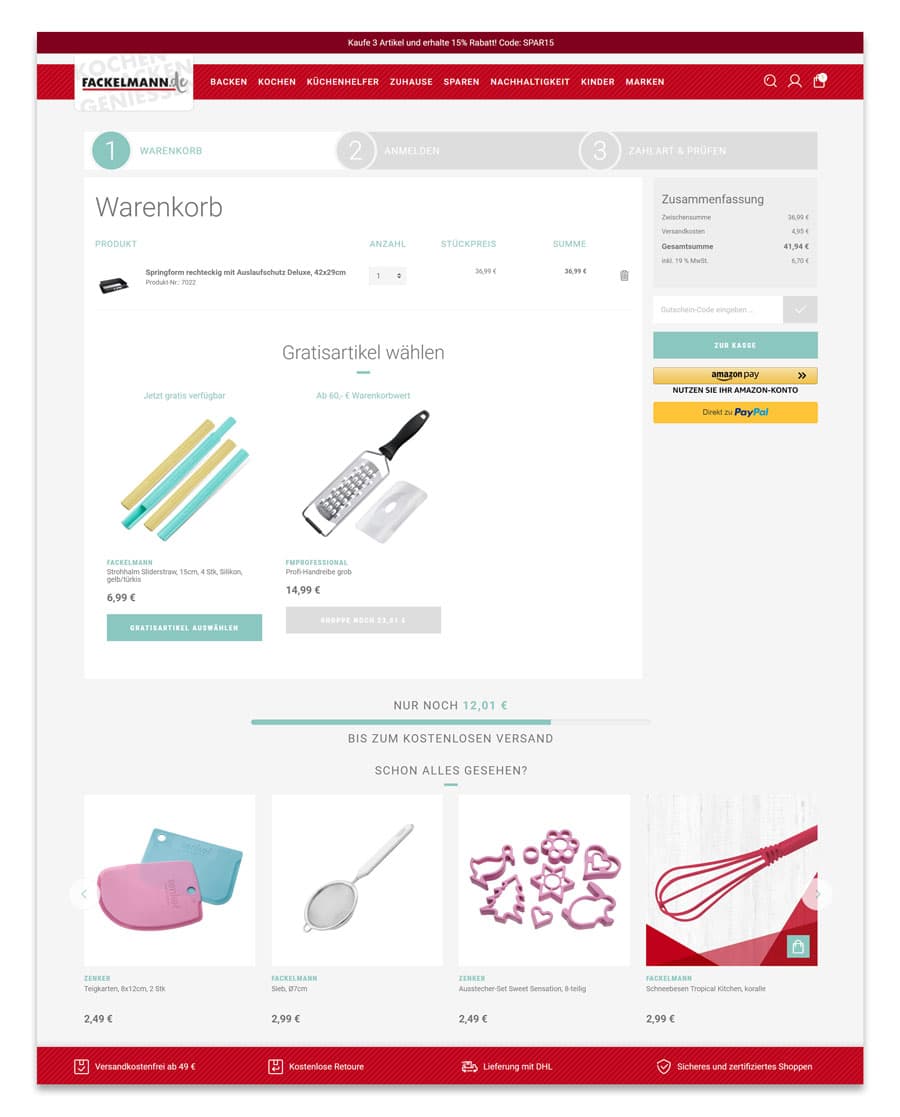
Fackelmann inspires customers in their shopping cart with product recommendations to bridge the gap to free shipping.
(Source: Screenshot from fackelmann.de)
You can also use a threshold value for discounts. For example, your shop visitors receive a $5 discount on purchases over $50. You can further stagger these discounts, for example, a $12 discount on purchases over $100, $15 on purchases over $200, etc. As with free shipping, customers tend to select additional products in order to receive the discount.
A countdown to discounts is a powerful psychological tool for encouraging shop visitors to make a purchase. The feeling of urgency and the fear of missing out motivates customers to act quickly. Examples include: "20 percent off dresses today only" or "Until the end of the month only: 10 percent discount on all our top sellers."
Loyalty programs not only strengthen your customers' loyalty to your online store, but also create another opportunity to increase the average shopping cart value and repurchase rate. You can design loyalty programs in different ways:
Stay up to date on personalization: Sign up for the Epoq newsletter.Sign up now!
Whether for bouquets of flowers, coffee, or contact lenses, subscriptions ensure regular income for your online shop and save your customers time. Depending on the product category, you can offer different subscriptions and terms. Sending a refill box is particularly suitable for consumer goods that your customers would order again and again. With a curated box, you can introduce your customers to new products or surprise them with a careful selection. Well-known examples of this are HelloFresh from the food industry and GLOSSYBOX from the beauty sector.
Similar to subscriptions, bundles allow you to increase your average basket value and offer your customers time and money savings as added value. You can put together product packages that you sell at a flat rate. For example, combine popular products with "slow-moving items." Or you can suggest products to your shop visitors that other customers have purchased together. They can then get these products as a set at a lower price. To display these personalized product recommendations, you can rely on a recommendation system.
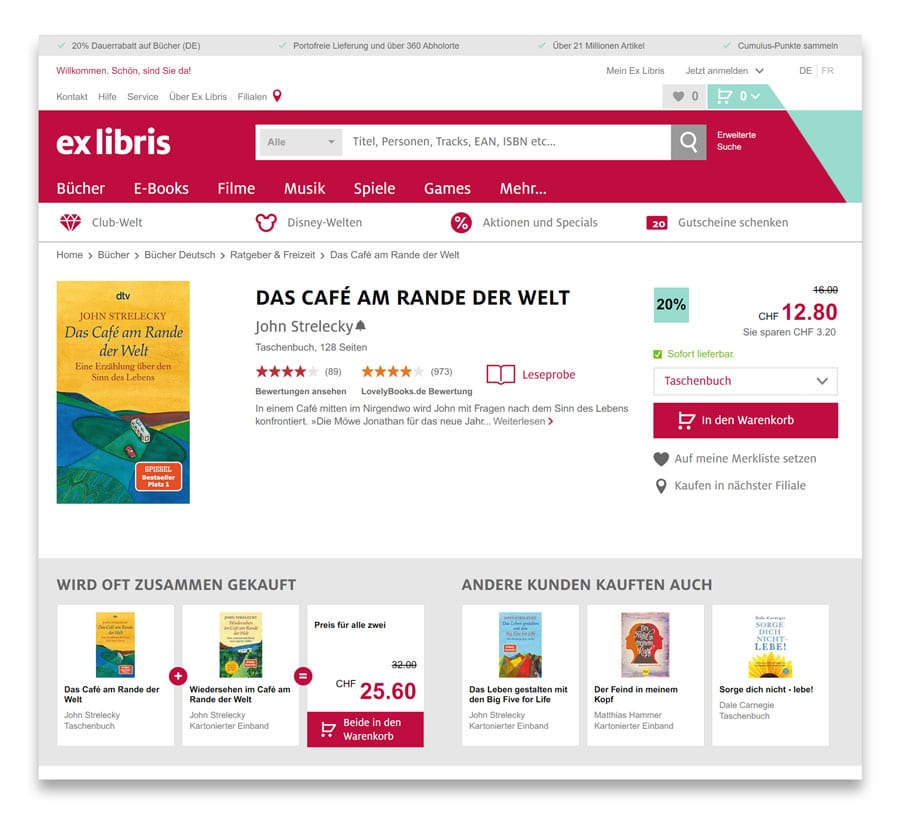
On the product detail page, Ex Libris displays bundle recommendations to customers in the style of "Frequently bought together."
(Source: Screenshot from exlibris.ch)
When shop visitors feel personally addressed by product recommendations, they are more likely to buy them. According to a study by Actico, 43 percent of German consumers prefer personalized offers. 41 percent of those surveyed consider it a waste of time to look at products that are not personally tailored to them.³
Once your shop visitors have filled their shopping carts, you can generate additional sales through cross-selling and upselling. Cross-selling involves suggesting products that go well with the items originally selected, such as a bicycle repair kit to go with a new bike. Upselling involves offering your customers a higher-quality version of the product they intend to buy, such as a laptop with a faster processor.
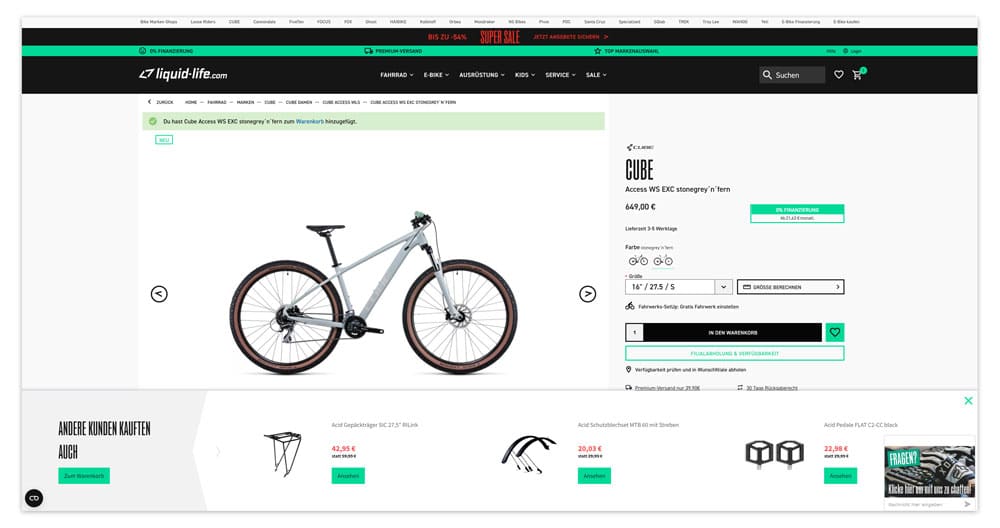
When customers click on the shopping cart button, Liquid-Life displays matching cross-selling products in a shopping cart layer.
(Source: Screenshot from liquid-life.de)
It's worth taking a close look at the average shopping cart value in your online store. Not only will you learn more about your customers and their purchasing behavior, but you can also strengthen their loyalty to your company and brand through various marketing measures. In addition, a higher average shopping cart value will increase your sales and profits.
Sources: ¹ intelliAd, ² Webinterpret, ³ eCommerce Magazine
Definition: The average shopping cart value is an important metric in e-commerce. It indicates how much your customers spend on average per order.
That depends on the target group and the industry. In stores that sell furniture, travel, or luxury goods, the average shopping cart value is much higher than, for example, electronics, fashion, or books.
With a higher average shopping cart value per customer, you increase your sales. This allows you to work in a more cost-effective manner. At the same time, in combination with various marketing measures, you can also strengthen your customers' loyalty to your company.
You can use various marketing measures: loyalty programs, subscription models for your products, cross-selling and upselling, as well as free shipping or additional discounts above a certain threshold. Personalized offers that are particularly relevant to your shop customers are also very convincing.
A recommendation system that displays personalized product recommendations is just as helpful as guided selling, which intuitively advises your customers on products.
Want to increase your shopping cart value with personalized product recommendations?
Then schedule a web demo now!

You are currently viewing placeholder content from HubSpot Embedded Content. To access the actual content, click the button below. Please note that doing so will result in data being shared with third-party providers.
More InformationYou are currently viewing placeholder content from HubSpot. To access the actual content, click the button below. Please note that doing so will result in data being shared with third-party providers.
More InformationYou are currently viewing placeholder content from HubSpot Meetings. To access the actual content, click the button below. Please note that doing so will result in data being shared with third-party providers.
More Information