
4.23% higher click-through rate on product overview pages thanks to self-learning ranking at A-Z Gartenhaus
A-Z Gartenhaus increased the click-through rate on product overview pages by more than 4% using a self-learning ranking system.

Product overview pages are very important in online shops. They present your product range and provide guidance to shop visitors. That's why they also have enormous potential to optimize your conversion rate, generate more sales, and build customer loyalty to your company. This article shows you why product overview pages are so important, how to design them correctly, and how to add the finishing touch with personalization.

Here'swhatyou can expect to find in this blog article:
What are product overview pages?
Different types in the online shop
Functions in online shops
Why is the product overview page so important?
Checklist: How to design the perfect product overview page
Enhancement of the product overview page through personalization
Conclusion: Design your product overview pages in a well-thought-out and personalized manner.
Product overview pages (also known as product listing pages) are entry pages in your online shop where your customers can find all products related to a specific topic. In addition to the product list, you can provide your users with further information on this page, such as the quality and features of your products, the promised benefits, or even more general content that appeals to the emotions of shop visitors.
There are two types of product overview pages:
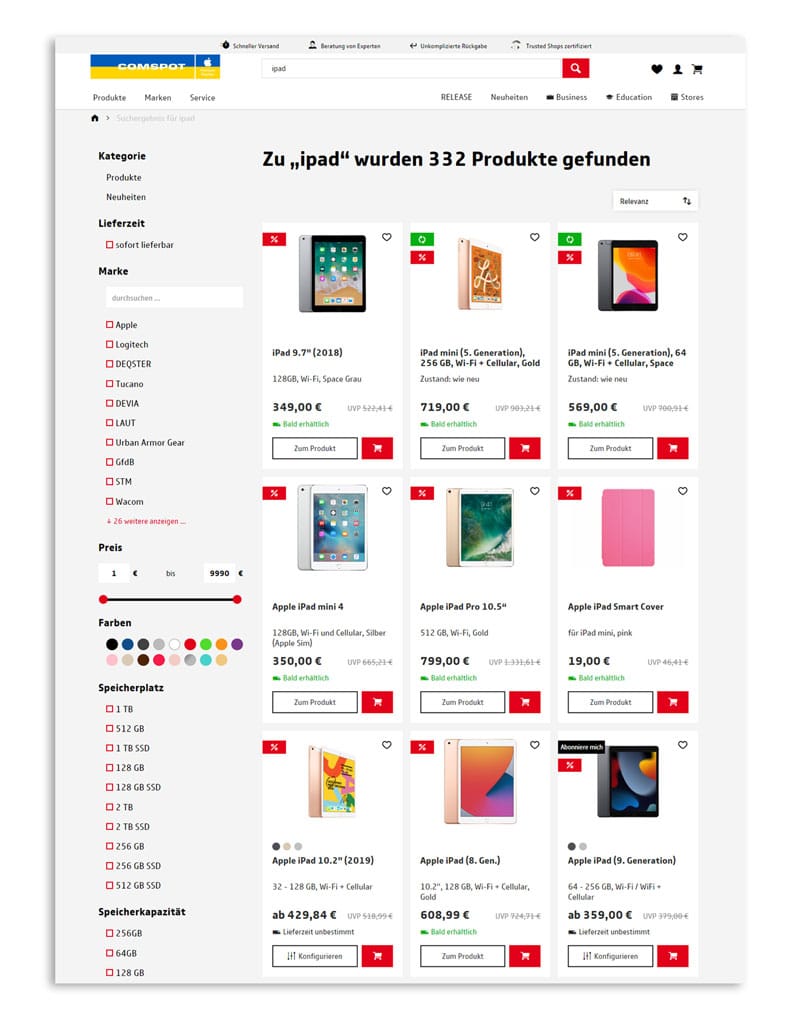
On the COMSPOT search results page for the term "iPad," shop visitors can immediately see relevant results with important information such as storage capacity, price, and color options.
(Source: Screenshot from comspot.de)
Category and search results pages can fulfill a variety of functions:
Stay up to date on personalization: Sign up for the Epoq newsletter. Register now!
Product overview pages can also function as distribution pages in online shops. They then act as a hub and refer to other subpages. This is typical in large main categories that refer to subcategories.
The category page on the topic of "gardening" in Hornbach's online shop, for example, does not show a single product – instead, it displays numerous tiles sorted by topic with links to subcategories such as "garden furniture," "patio construction," or "garden shears." Distribution pages do not focus on content; rather, they serve to provide orientation and thus guide users through the online shop.
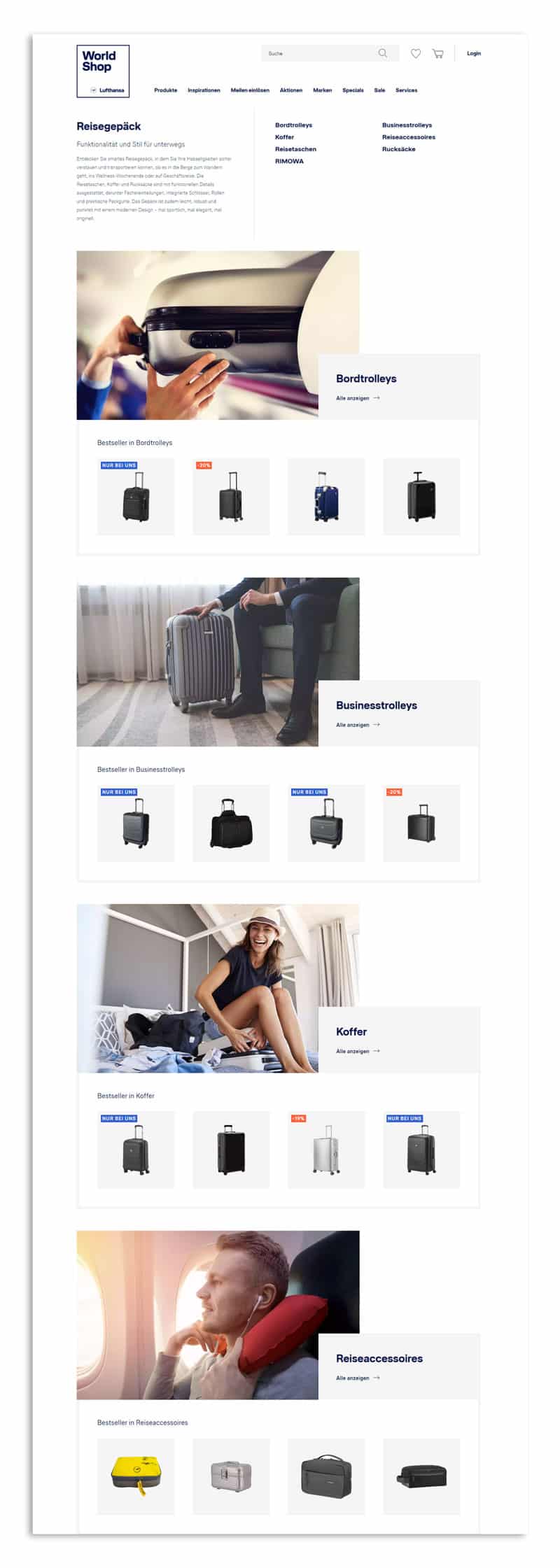
On the "Luggage" product overview page in the Lufthansa WorldShop, shop customers can get a good overview of the various subcategories and an insight into the respective product range.
(Source: Screenshot from worldshop.eu)
An appealing design of search results pages and product categories is essential for e-commerce marketing:
In summary: The product overview page is a central point of contact for your online shop visitors and should therefore be consistently tailored to their needs.
What the perfect product overview page looks like is very individual and depends on your shop and your customers. First, ask yourself what their search intent is. What are they looking for when they visit your online store? Do they want to find out more or are they ready to buy? Do they have a specific idea in mind or do they just want to browse? Keep the answers to these questions in mind as you go through our checklist for your converting product overview page:
The best way to find out which elements of your product overview page are most popular with your shop visitors is to use A/B testing. Special tools display two versions of the same page simultaneously and test which one achieves more conversions. This allows you to gradually adjust your product presentation and customer approach.
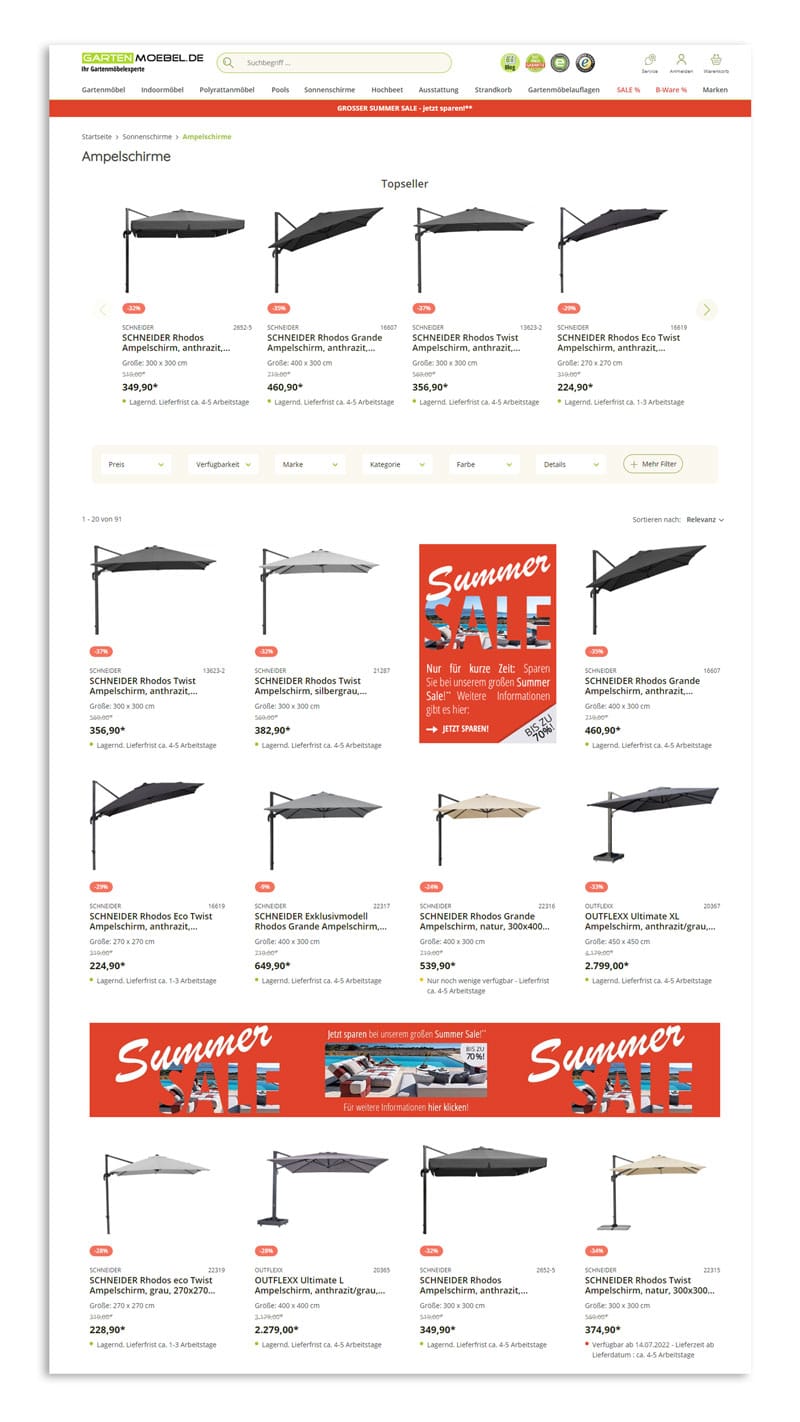
GARTENMOEBEL.DE impresses on category pages with top seller product recommendations, filter options, well-thought-out product sorting, and banners within the product list, among other features.
(Source: Screenshot from gartenmoebel.de)
Stay up to date on personalization: Sign up for the Epoq newsletter. Register now!
A study on this topic shows that more than two-thirds of online shoppers are willing to share their personal preferences with online stores in order to improve their shopping experience.¹ You should take advantage of this willingness by offering them a personalized shopping experience. You can also use personalized elements on the product overview page, for example:
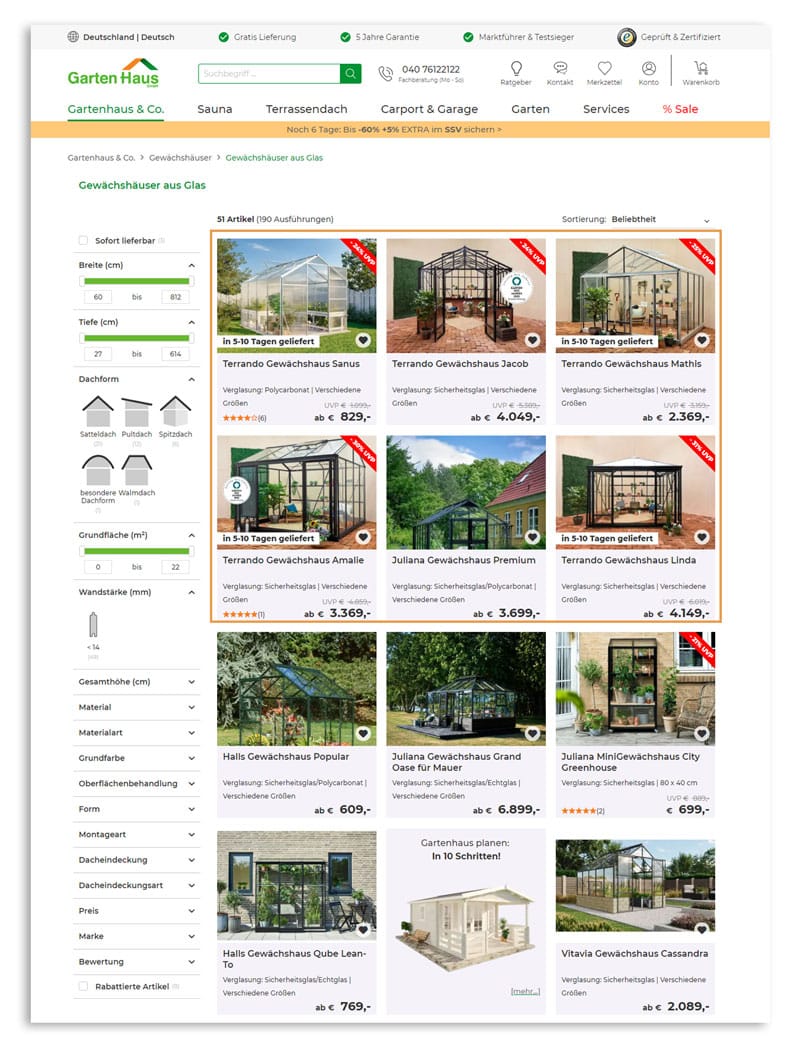
GartenHaus GmbH focuses on personalization and displays the first six results on the product overview pages based on individual click and purchase behavior.
(Source: Screenshot from gartenhaus-gmbh.de)
If shop visitors find what they are looking for on the product overview page, this significantly increases the likelihood of a purchase. Carefully designing and continuously optimizing search results and category pages is therefore a crucial component for improving conversion rates and increasing sales. Always keep your customers' needs in mind and use personalization to create an individual shopping experience for each shop customer—this is almost a guarantee for success.
Source: ¹ e-tailment
Product overview pages, such as category or search results pages, present products from an online store that match a specific topic and/or simplify navigation to subcategories.
The product overview page provides guidance to your shop visitors, presents your products clearly, and serves as inspiration. It also offers enormous potential for search engine optimization.
All elements of a good product listing page are geared toward the needs of users, from the header and introduction as the first impression to the well-thought-out arrangement and presentation of the products to the curated content.
The content should offer the reader added value and be optimized for search engines. A clear structure and easily understandable language are particularly important here.
There are numerous approaches to personalizing a product listing page, for example based on previous purchases or known customer preferences. Individual product sorting or personalized product recommendations are typical examples.
Want to know how GartenHaus GmbH achieves higher click-through rates on product overview pages?
Get our case study!

You are currently viewing placeholder content from HubSpot Embedded Content. To access the actual content, click the button below. Please note that doing so will result in data being shared with third-party providers.
More InformationYou are currently viewing placeholder content from HubSpot. To access the actual content, click the button below. Please note that doing so will result in data being shared with third-party providers.
More InformationYou are currently viewing placeholder content from HubSpot Meetings. To access the actual content, click the button below. Please note that doing so will result in data being shared with third-party providers.
More Information