
E-book – Personalization in E-commerce
In this e-book, you will learn why personalization is important in e-commerce and what the term personalization actually means.

Buying concert tickets on your smartphone, ordering shoes on your tablet—in mobile commerce, online transactions take place exclusively via mobile devices. Because the majority of customers today prefer to shop flexibly using their cell phones, mobile commerce plays an important role in any business strategy. Here you can find out how it differs from e-commerce, when m-commerce emerged, and how it has developed. We'll also reveal how you can use it to increase your conversion rate.

Here'swhatyou can expect to find in this blog article:
Mobile commerce – what you need to know
Mobile commerce as a flexible relative of e-commerce
E-commerce vs. m-commerce
The development of mobile commerce over time
Mobile commerce – what it involves
Components of mobile commerce
Examples of m-commerce
M-commerce in practice – how to use mobile commerce profitably for your business
Points to consider
Advantages and disadvantages of m-commerce
When it comes to online shopping, people usually talk about e-commerce. In order to meet the purchasing behavior of your customers today and retain visitors to your shop, the use of mobile commerce as a special form of e-commerce is essential. You will find a definition of this term and everything else you need to know about this topic in the following sections.
TheGabler Business Dictionary defines mobile commerce as a special form of e-commerce that uses mobile devices.¹ Devices such as smartphones or tablets are used to initiate, process, and maintain the exchange of so-called service processes. In the next step, we will take a look at the differences between m-commerce and e-commerce.
According to a study by VuMA , 94.2% of 14- to 19-year-olds, 95.5% of 20- to 29-year-olds, and 96% of 30- to 39-year-olds in Germany already owned a smartphone in 2021.² These figures clearly show how important it is to understand how e-commerce works and what lies behind it.
Stay up to date on personalization: Sign up for the Epoq newsletter.Sign up now!
Online shopping has long been part of our everyday lives. Back in 2011, the majority of shoppers surveyed in a study by Deutsche Post DHL Group rated online shopping as more advantageous than brick-and-mortar retail.³ The most convincing factors here were the opportunities for special offers and the time savings.
Mobile commerce serves these two aspects of online retail even more precisely than transactions on stationary Internet-enabled devices. This is because smartphones are ideal for satisfying purchasing and information needs on the go and at any time. The smaller display format forces sellers to present the purchasing process in an even clearer way and to simplify procedures so that potential buyers can quickly find the product they want. M-commerce therefore offers great potential. Holistic one-to-one marketing also allows you to increase your conversion rate in the long term.
E-commerce has been around for more than two decades, if we consider the first purchase made via the internet as we know it today to be its beginning. On August 11, 1994, the world's first documented sale via an online shop, including encrypted credit card payment, took place.⁴
Mobile commerce is linked to the introduction of smartphones and other mobile devices. Despite the first smartphone being launched in 1996, m-commerce did not emerge until somewhat later. Although early generations of smartphones had Internet access, their data transfer rates were too low. Large websites made mobile shopping a test of patience.
It was only with the launch of the iPhone in 2007 that online shopping became a real option – thanks to its touchscreen. Its easy, intuitive operation provided the ideal starting point for the development of technologies and structures that made online shopping possible on mobile devices. According to Bitkom Research, the number of purchases made via mobile devices doubled between 2014 and 2017 alone.⁵ In 2021, according to another survey by DPD, 56% of Germans surveyed already use a smartphone and 30% use a tablet to place orders.⁶
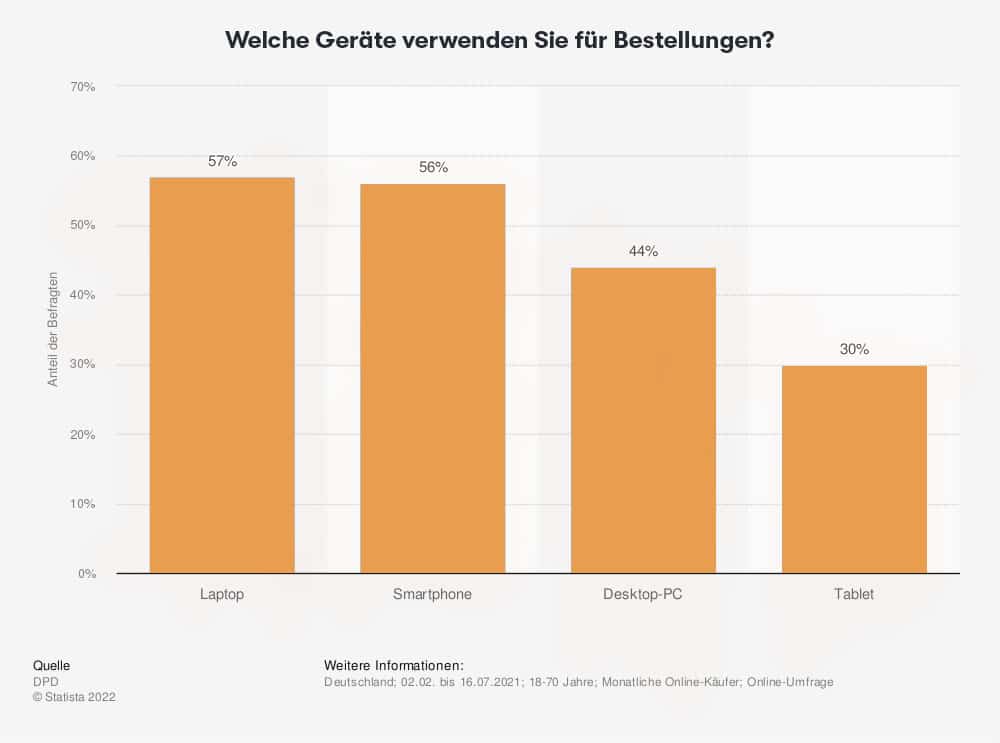
Many users use smartphones or tablets to place orders, which demonstrates the growing importance of mobile commerce.
(Source: Screenshot from Statista, survey by DPD⁶)
To optimize the conversion rate for your shop, you should be familiar with all elements of m-commerce and understand how they work. In the next section, we will give you an overview of the components and show you examples of successful strategies.
M-commerce consists of the following elements:
There are many examples of successfully implemented mobile commerce. We have compiled three important examples for you:
Amazon: The most successful online shopping platform generated over €15 billion in 2021.⁷
OTTO: With €5.1 billion in sales, the globally active retail and service group ranks second among the most important players in online business.⁷ OTTO offers its customers the opportunity to buy directly via an app and makes this particularly attractive with discount campaigns.
Zalando: The fashion company recorded total sales of more than €2.5 billion in 2021.⁷ The proportion of visitors to the platform via mobile devices was over 86% in the previous year (2020), and 57% of purchases were made via the company's own app.⁸
So far, we have discussed background information and successful examples. Below, we provide valuable tips on how you can implement your m-commerce strategy and improve the digital customer experience. After all, it is essential to keep an eye on the latest trends in online retail.
The way you use a mobile device differs from the way you use a desktop computer. You should always keep this in mind and gear your e-commerce toward mobile if you want to focus on m-commerce. In the following sections, we will reveal which aspects are of central importance for mobile commerce and why.
Most websites today are already created using responsive design, which adapts to the screen size of the mobile device being used. To improve usability for your customers, you should go into even more detail when designing your shop.
Clear menu navigation, which is achieved through a well-designed navigation structure, among other things, is crucial. As soon as menus become too comprehensive, even responsive design cannot adapt them to smaller displays; complete information cannot be read without scrolling. In addition, product overview pages such as category pages should function under demanding conditions of use. If you label individual categories in your shop with images, buyers with a poor mobile connection may not be able to find their way around, as images require more data volume.
You can read about other elements that are generally crucial for good user guidance in our article on this topic.
Another key element in optimizing your website for mobile use is the search function. Most users are accustomed to seeing suggestions for the letters they have already typed when entering search terms. A so-called autosuggest function simplifies the search process for anyone browsing on the go who doesn't want to type long words on their touchscreen.
You can find out everything else you need to know about onsite search in e-commerce in our article on this topic.
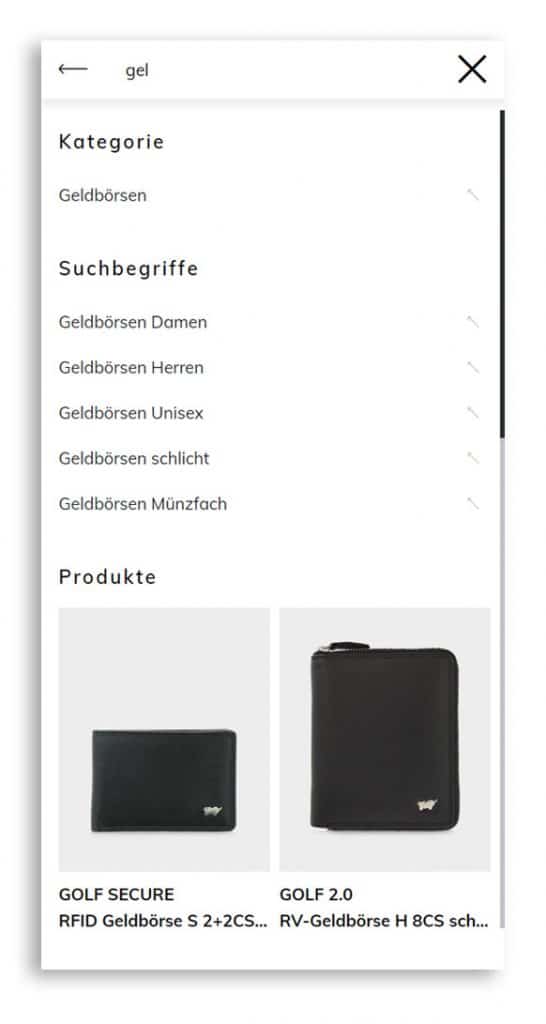
You can also support your customers on mobile devices with a typeahead function during their search, displaying relevant search suggestions and products as soon as they start typing.
(Source: Screenshot from braun-bueffel.com)
As we have already shown with examples of successful e-commerce and m-commerce companies, shopping apps contribute to strong customer loyalty and increase your conversion rate. You can offer existing customers in particular many advantages with an app: by entering their data once, they save time on their next purchase and you can respond even more precisely to their preferences and shopping habits with targeted one-to-one marketing. Above all, the payment process should be as simple as possible by integrating mobile payment service providers such as PayPal or Google Pay.
For more tips on how to leverage the sales potential of the checkout process, check out our blog article on the topic.
Whether on desktop or mobile, customers want to be addressed individually and feel personally engaged. To achieve this, you can use personalization. This turns your online store into a digital sales assistant, even on mobile devices, and enables 1:1 communication with customers. Throughout the entire digital customer journey, you can respond to the different needs of your shop customers and thus create unique shopping experiences on all mobile devices: from orientation and advice to inspiration and customer loyalty.
Stay up to date on personalization: Sign up for the Epoq newsletter.Sign up now!
Find out in another article how personalization can make your onsite marketing a highlight.
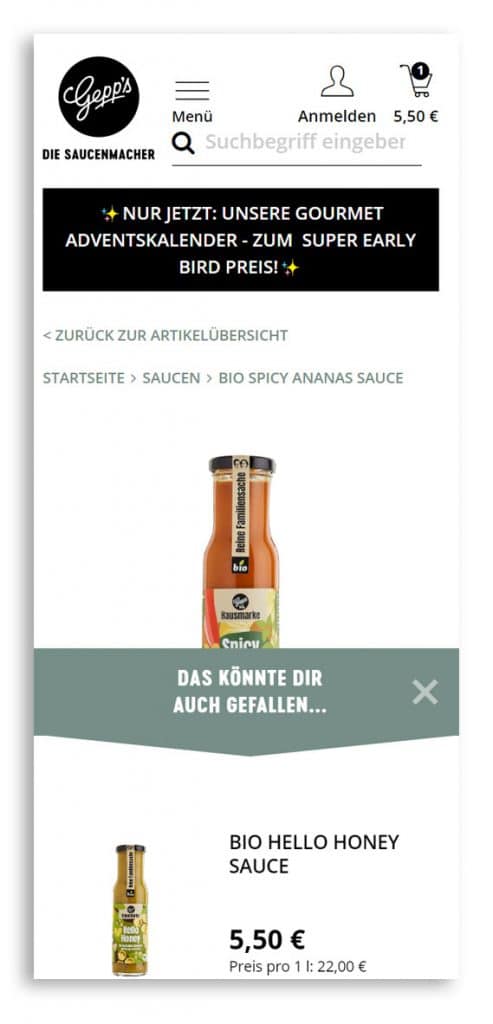
Gepp's displays relevant cross-selling products in the shopping cart layer as soon as a customer adds a product to their cart.
(Source: Screenshot from gepps.de)
M-commerce offers many advantages and only a few disadvantages. Every company is delighted that mobile shopping on constantly available smartphones and tablets facilitates impulse purchases. Greater proximity to customers, more direct interaction, and closer ties also speak in favor of mobile commerce. Negative aspects include limited display options due to smaller screens and more cumbersome text entry for users.
It's a development that no one can stop—m-commerce has long been an integral part of e-commerce. And because it's more important than ever for shop operators to know exactly what their customers want and be able to meet their needs, you should take full advantage of the potential of mobile commerce. Only by staying close to your customers can you identify trends and developments in time to adapt your business strategy accordingly. If you use mobile commerce in a targeted manner and make the appropriate optimizations, not only will your customers enjoy flexible handling, but you will also benefit from its use by boosting your conversion rate.
Sources: ¹ Gabler Business Dictionary, ² VuMA, ³ Deutsche Post DHL Group, ⁴ Handelsblatt, ⁵ Bitkom Research, ⁶ DPD, ⁷ EHI Retail Institute, ⁸ Carpathia
M-commerce or mobile commerce is a special form of e-commerce in which the initiation, processing, and maintenance of the exchange of service processes takes place via mobile devices.
M-commerce includes mobile advertising, SMS payment services, mobile payments, mobile banking, reservations and bookings for events or services, and mobile apps.
For shop operators, m-commerce brings more advantages than disadvantages. It offers the opportunity to accompany customers in their everyday lives and reach them with targeted content. A well-thought-out concept for a responsive shop page is essential for success in m-commerce.
In addition to responsive design, clear menu navigation and category pages are crucial, which are displayed correctly even with a poor mobile connection. The shop's search engine should be equipped with an autosuggest function. Shop operators can also retain customers with their own app. Personalization is the key success factor for addressing shop customers individually on mobile devices and creating unique shopping experiences.
Mobile commerce emerged with the introduction of smartphones in 1996, but it was not until Apple invented the touchscreen in 2007 that shopping via mobile devices became mainstream.
Are you interested in personalization in e-commerce?
Download the right e-book now!

You are currently viewing placeholder content from HubSpot Embedded Content. To access the actual content, click the button below. Please note that doing so will result in data being shared with third-party providers.
More InformationYou are currently viewing placeholder content from HubSpot. To access the actual content, click the button below. Please note that doing so will result in data being shared with third-party providers.
More InformationYou are currently viewing placeholder content from HubSpot Meetings. To access the actual content, click the button below. Please note that doing so will result in data being shared with third-party providers.
More Information