
E-book – Personalization in E-commerce
In this e-book, you will learn why personalization is important in e-commerce and what the term personalization actually means.

Consistent personalization of your customers' shopping experience is the basis for success in e-commerce today. Only with well-thought-out onsite marketing that puts you one step ahead of your competitors can you increase your sales and generate more conversions. In this article, you will learn what measures you can take to get the most out of your onsite marketing in e-commerce and what goals you can achieve with it.

Here'swhat you can expect to find in this blog article:
Definition: What is onsite marketing in e-commerce?
What is the difference between onsite and offsite marketing?
What are the objectives of onsite marketing campaigns?
The best onsite marketing measures in e-commerce
1) Online purchasing advice in e-commerce
2) Optimizing the user experience
3) Exclusive offers
4) Personalization in onsite marketing
How can personalization improve onsite marketing?
Conclusion: Excellent onsite marketing thanks to a high degree of personalization
As the name suggests, onsite marketing revolves around marketing options that you can implement directly in your online store. You customize your website to the needs of your visitors in order to optimize their user experience and thus increase your sales.
Offsite marketing takes place outside of your online store. It aims to make your brand better known and more visible and to attract more visitors—in other words, to increase traffic. Email personalization, for example, can be used for this purpose. In contrast, onsite marketing focuses on making better use of existing traffic, such as increasing the average cart size, generating more conversions, or acquiring more new customers.
Stay up to date on personalization: Sign up for the Epoq newsletter. Register now!
With the thoughtful use of onsite marketing tools, you can achieve a lot of goals. This allows you to
If you want to implement optimal onsite marketing in your online shop, you can choose from a variety of measures. Here are a few examples that are particularly effective:
Salespeople in brick-and-mortar stores have an advantage: they can show products, explain their benefits, and appeal directly to the user's emotions. Although classic one-to-one marketing cannot be implemented in e-commerce in exactly the same way as in a brick-and-mortar store, there are still a number of ways in which you can guide your customers digitally and provide them with the best possible advice. Various online consulting software programs are suitable for this purpose, for example:
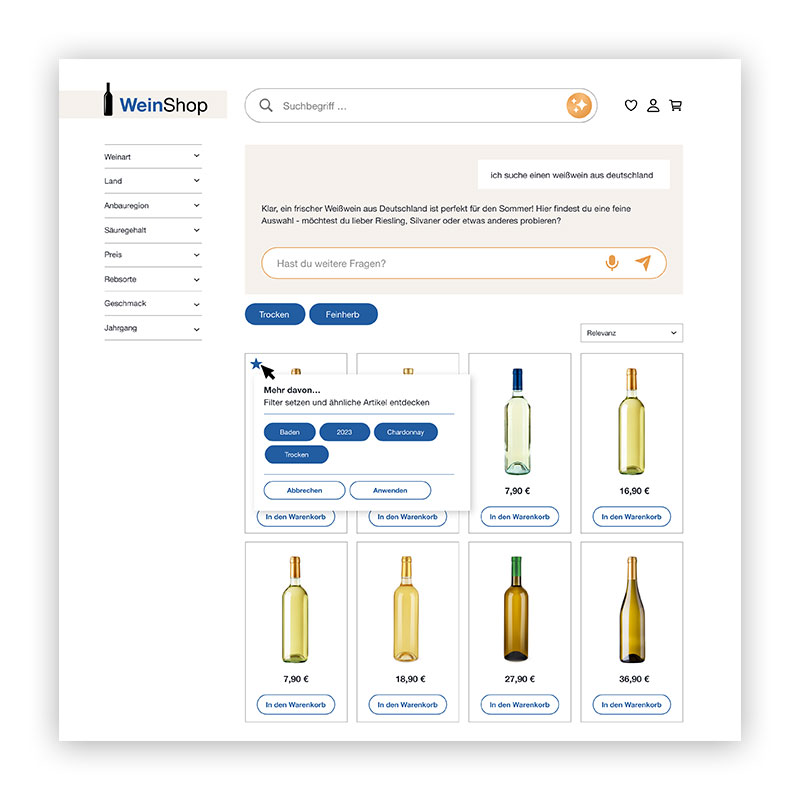
Example of an AI shopping assistant in a wine shop to assist with product selection. (Source: Own illustration)
A positive user experience can encourage your customers to spend more money. It is therefore worthwhile for you to optimize the user experience (UX). It consists of the following four areas, among others:
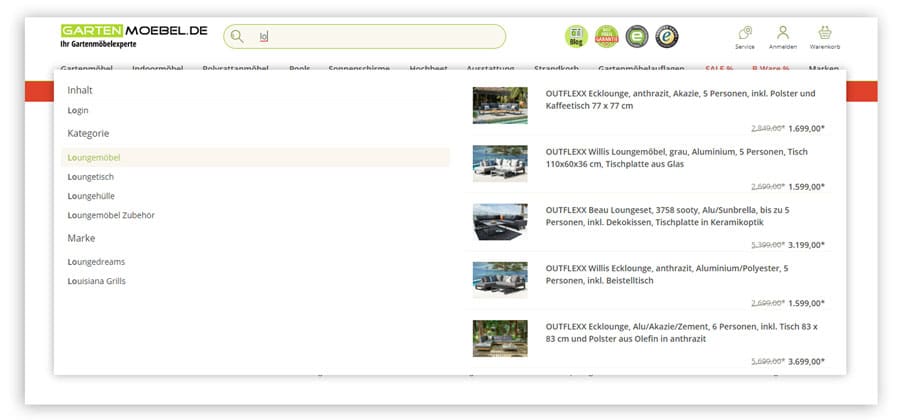
An ecommerce search engine function that displays suitable product suggestions as soon as you start typing is one way to optimize the user experience.
(Source: gartenmoebel.de)
Offers that give your customers a feeling of exclusivity can also increase the average shopping cart value, prevent abandoned purchases, and increase sales. For example, the Tchibo.de online shop regularly offers changing product ranges. Holders of the TchiboCard customer card can order these a week before all other customers.²
The key to such offers is ideal placement: if a promotion is hidden in a slider, customers will hardly notice it—and certainly not if they access it directly via a search engine.
So display the offers at the right time, for example, an exit intent pop-up when a purchase is about to be abandoned.
E-commerce personalization is the highlight of your onsite marketing. It allows you to make the shopping experience more personal and gives customers the feeling that they are in good hands and making the right decision. We have compiled three examples of possible personalization measures that you can implement with personalization software below:
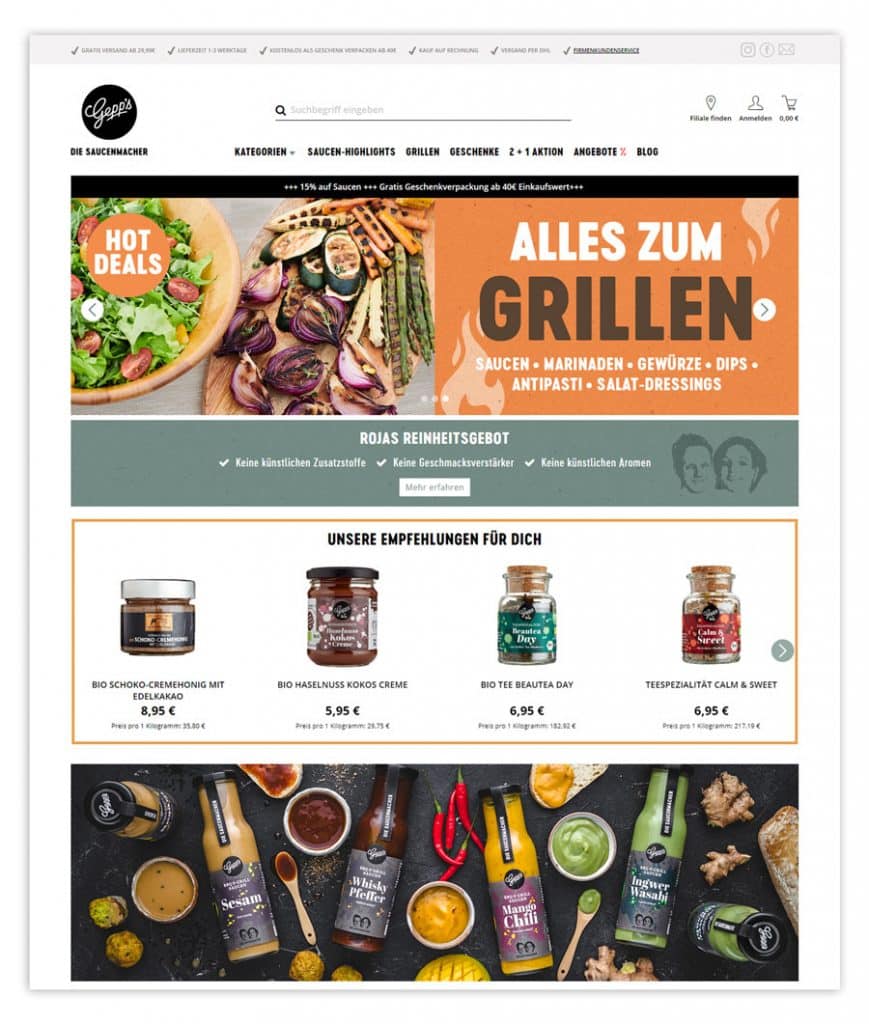
Personalized product recommendations on the homepage immediately capture the attention of online shoppers and also allow them to quickly begin the purchasing process.
(Source: Screenshot from gepps.de)
Real-time personalization is crucial for an optimal shopping experience: artificial intelligence adapts to customer requirements in real time based on current and expected future behavior.
Stay up to date on personalization: Sign up for the Epoq newsletter. Register now!
Onsite marketing campaigns without personalization always remain one-dimensional. This is because the decision to display an offer or product recommendation in the online shop is based on rules that have been set up manually in advance. Since these rules do not respond to the customer's needs in real time, they cannot optimally address the customer's situation. AI-supported 1:1 personalization in onsite marketing campaigns, on the other hand, offers many advantages. These include, for example
Onsite marketing provides you with a wealth of opportunities to increase your sales and conversions. Whether it's 1:1 video consulting, UX optimization, or personalized offers, there are suitable onsite marketing measures for every online shop. Personalization in particular allows you to stand out and address each individual customer with relevant content. This gives you a real competitive advantage and puts your success on a secure footing.
Sources: ¹ Saturn, ² Tchibo, ³ McKinsey & Company
Onsite marketing is based on marketing measures that take effect directly in your online shop.
Offsite marketing ensures that traffic to the online store is increased. Onsite marketing, on the other hand, works to generate more conversions and higher sales from existing traffic.
Onsite marketing measures improve the shopping experience and thus help you achieve larger shopping carts, higher sales, and more conversions. In addition, you strengthen customer loyalty and reduce the bounce rate.
Artificial intelligence is capable of analyzing customers' clicking and purchasing behavior and using this information to derive relevant content, such as tailored recommendations.
Part of onsite marketing is optimizing the user experience for customers, for example through clear navigation, short loading times, responsive design, or useful content.
Want to take your onsite marketing to the next level?
Get our free e-book on personalization in e-commerce now!

You are currently viewing placeholder content from HubSpot Embedded Content. To access the actual content, click the button below. Please note that doing so will result in data being shared with third-party providers.
More InformationYou are currently viewing placeholder content from HubSpot. To access the actual content, click the button below. Please note that doing so will result in data being shared with third-party providers.
More InformationYou are currently viewing placeholder content from HubSpot Meetings. To access the actual content, click the button below. Please note that doing so will result in data being shared with third-party providers.
More Information