
E-commerce trends for 2022 | Keeping pace with customer demands
Malte Feiler (epoq) and Marco Kohm (Spryker) will show you how to implement the latest e-commerce trends in your shop using various best practices and how-to guides.

Can e-commerce prevail over brick-and-mortar retail, or will they continue to share the market in the future? E-commerce has already taken a large slice of the pie from brick-and-mortar retail. The 2021 Online Monitor from the German Retail Association shows that, excluding the food sector, online retail already accounts for 18 percent of the market.¹ Find out here how unusual industries are successfully making the leap into online retail.

Here'swhatyou can expect to find in this blog article:
Online retail vs. brick-and-mortar retail: the differences
Advantages of online retail
Advantages of brick-and-mortar retail
Hybrid forms of both models
E-commerce and brick-and-mortar retail: the market in statistics
Missed opportunities: Why some industries fear online retail
Innovative online solutions: Entry opportunities for traditionally stationary industries
Nothing is impossible in e-commerce: Successful examples
Conclusion: Take advantage of the growing potential in online retail!
To understand the tension surrounding the link between online and brick-and-mortar retail, you should first take a closer look at the differences between the two retail strategies:
Both options have advantages for customers (the disadvantages arise from the advantages of the other option):
Stay up to date on personalization: Sign up for the epoq newsletter. Register now!
Retailers do not necessarily have to choose one of these models; a hybrid form is also possible:
According to the 2021 Online Monitor published by the German Retail Association (HDE) , online retail accounted for 12.6 percent of the total sales volume of €577 billion in the German retail sector in 2020. Adjusted for the food sector, the share is as high as 18 percent. Since statistics began to be recorded in 2000, there have been significant increases in the online share every year.²
Despite strong growth, some industries still rely primarily on brick-and-mortar retail and are underrepresented in online business. According to HDE Online Monitor, the three sectors CE/electronics (24.5 percent), fashion and accessories (23.1 percent), and leisure and hobbies (15.2 percent) accounted for the largest share of the approximately 72.8 million online transactions in 2020.³
The FMCG sector, which has enormous sales potential with food and everyday items, accounts for only 10.2 percent of online volume. Even weaker are the DIY & gardening (4.5 percent), health & wellness (6.0 percent), and home & furnishings (9.2 percent) sectors.⁴
There can be many reasons for this:
Even if a particular industry is not predestined for online retail, a successful entry into e-commerce is not necessarily impossible. Solutions are already in use today that solve typical challenges in online retail:
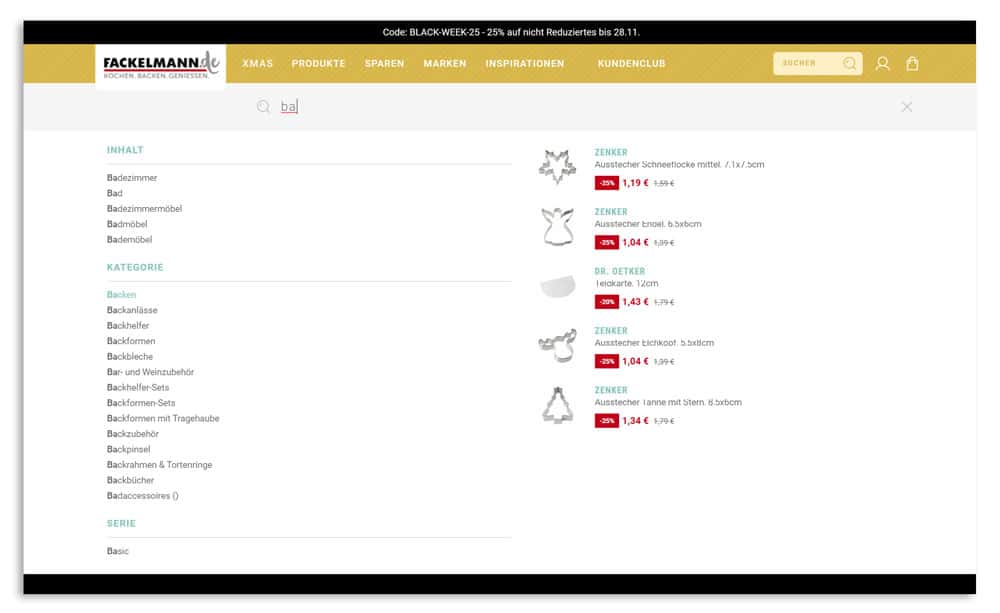
Thanks to intelligent search, customers in the Fackelmann shop receive suggestions as soon as they start typing and can search for specific characteristics, for example. (Source: Screenshot from fackelmann.de)
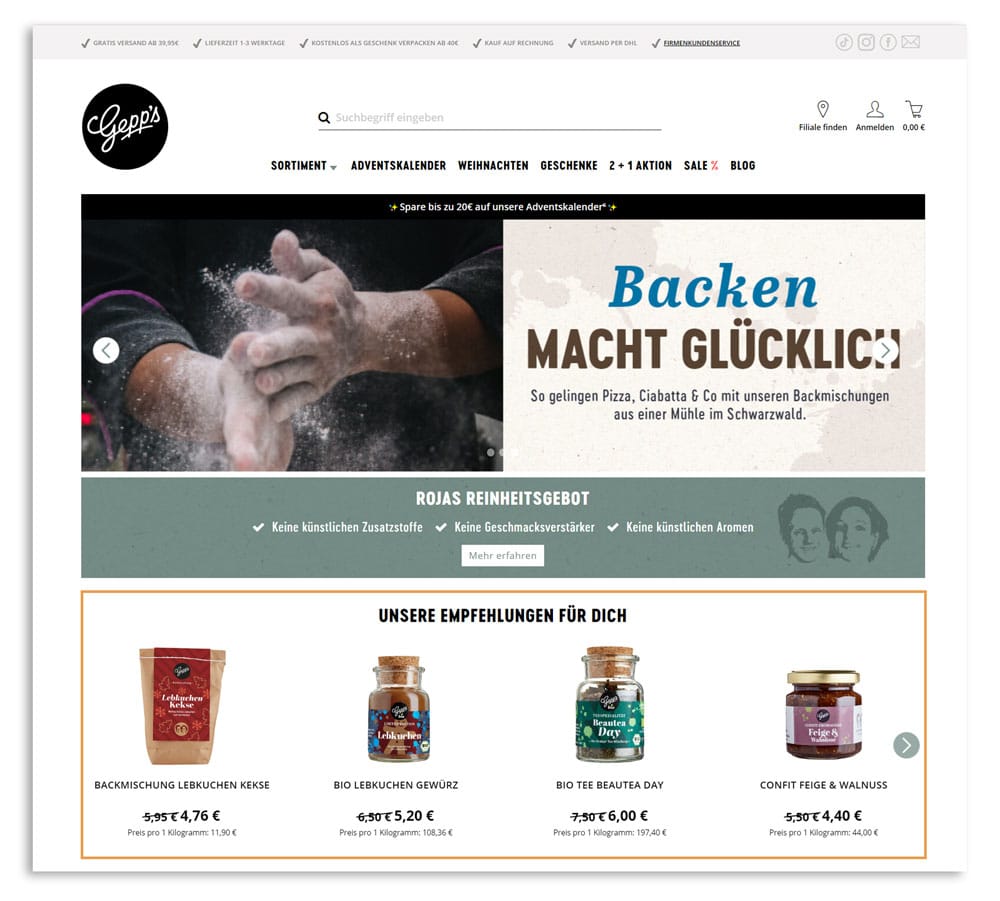
Gepp's displays personalized recommendations on the homepage of its online shop as soon as a shop visitor has a history. (Source: Screenshot from gepps.de)
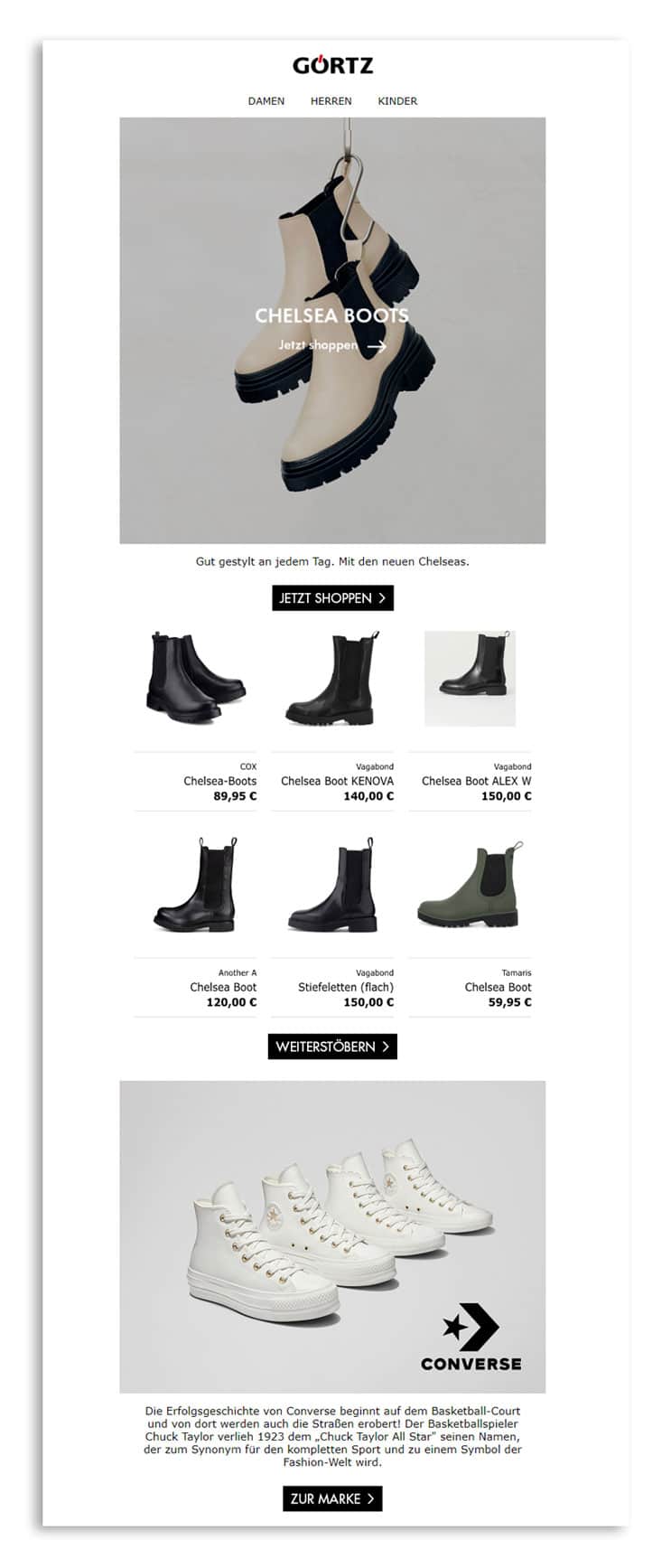
Görtz, for example, sends emails about specific categories with matching recommendations.
(Source: Email from goertz.de)
Numerous retailers have already faced the challenge of making their online business profitable despite products that require explanation or complex sales processes. With the right strategy, a well-thought-out customer journey, and a consistent focus on customer needs, they have succeeded. Here are a few successful examples:
The share of e-commerce in total retail sales will continue to grow steadily. Those who ignore this prospect will not only miss out on significant sales opportunities, but may also jeopardize their long-term competitiveness. This is because many of the challenges in e-commerce can now be overcome with innovative technologies.
Source: ¹, ², ³, ⁴ German Trade Association
According to the German Retail Association, consumer electronics and fashion and accessories account for almost half of all online sales.
Many brick-and-mortar retailers have to implement complex sales processes, have no solutions for transportation problems, or offer customizable products.
According to statistics from the German Trade Association, total retail sales in Germany amounted to €577 billion in 2020. Of this, 12.6 percent was attributable to online retail.
The integration of online and brick-and-mortar retail can be implemented in a variety of ways, such as online availability checks for items in the respective store, online video consultations in the customer's home, or the pickup of goods ordered online at a brick-and-mortar store.
Customers like shopping in online stores because they are not tied to a specific location or time, they save themselves the trip and the search for a parking space, and they can expect a larger selection of items at lower prices.
Are you looking for e-commerce trends?
Then watch our free webinar recording on e-commerce trends for 2022.

You are currently viewing placeholder content from HubSpot. To access the actual content, click the button below. Please note that doing so will result in data being shared with third-party providers.
More InformationYou are currently viewing placeholder content from HubSpot Meetings. To access the actual content, click the button below. Please note that doing so will result in data being shared with third-party providers.
More Information