
5.04% increase in sales per session thanks to new personalization strategy at Outletcity Metzingen
Outletcity Metzingen puts its personalization strategy to the test and increases revenue per session by 5.04%.

A three-course meal at your favorite restaurant, five pairs of socks for the price of three, or a package deal combining hotel and flight—product bundling has long been established in brick-and-mortar retail. But this sales strategy is also well suited to e-commerce. In the following article, we explain everything you need to know about product bundling, which products are suitable for it, and how you can generate higher shopping cart values in your online shop with product bundling.

Here'swhatyou can expect to find in this blog article:
Product bundling in e-commerce – what's behind it
These products are suitable for product bundling
The potential of bundling offers through cross-selling and similar strategies
Savings for customers and sellers – the advantages of product bundling in online shops
Product bundles as a selling point for shop visitors
Increased sales and lower costs for online retailers
Increasing the average shopping cart value with product bundles – what you should keep in mind
Product bundles as an exception, not the rule
Practical tips for creating product bundles in your online shop
Conclusion: Product bundles offer a whole host of advantages
Frequently asked questions about product bundles in e-commerce
In marketing, the term "product bundling" refers to the simultaneous sale of several products or services that have been combined into a single sales unit. To do this, two or more similar or related products are combined into one offer and sold for a total price. The product bundle is treated as a single product, so it has its own description, item number, etc. Alternatively, you can also display product bundles in the form of recommendations on the product detail page of a specific item and suggest them to online shoppers. For example, if a shop customer is on the product detail page of a novel, you can recommend a bundle offer consisting of the selected book and volume 2.
Products offered in bundles are usually cheaper than when purchased individually—this is known as subadditive bundling. Another variant is additive bundles, where the prices of the individual products are added together and there is no discount advantage for customers. This type of bundling primarily saves buyers time, as they do not have to search for any additional items they may need and add them to their shopping cart themselves.
A distinction is also made between pure bundling, where the products included are only offered together in a package, and mixed bundling, where the products can be purchased both as a bundle and individually. Product bundling is one of many effective strategies for increasing the average shopping cart value.
Product bundles can consist of goods or services. A combination of both is also possible. Typical examples of product bundling are:
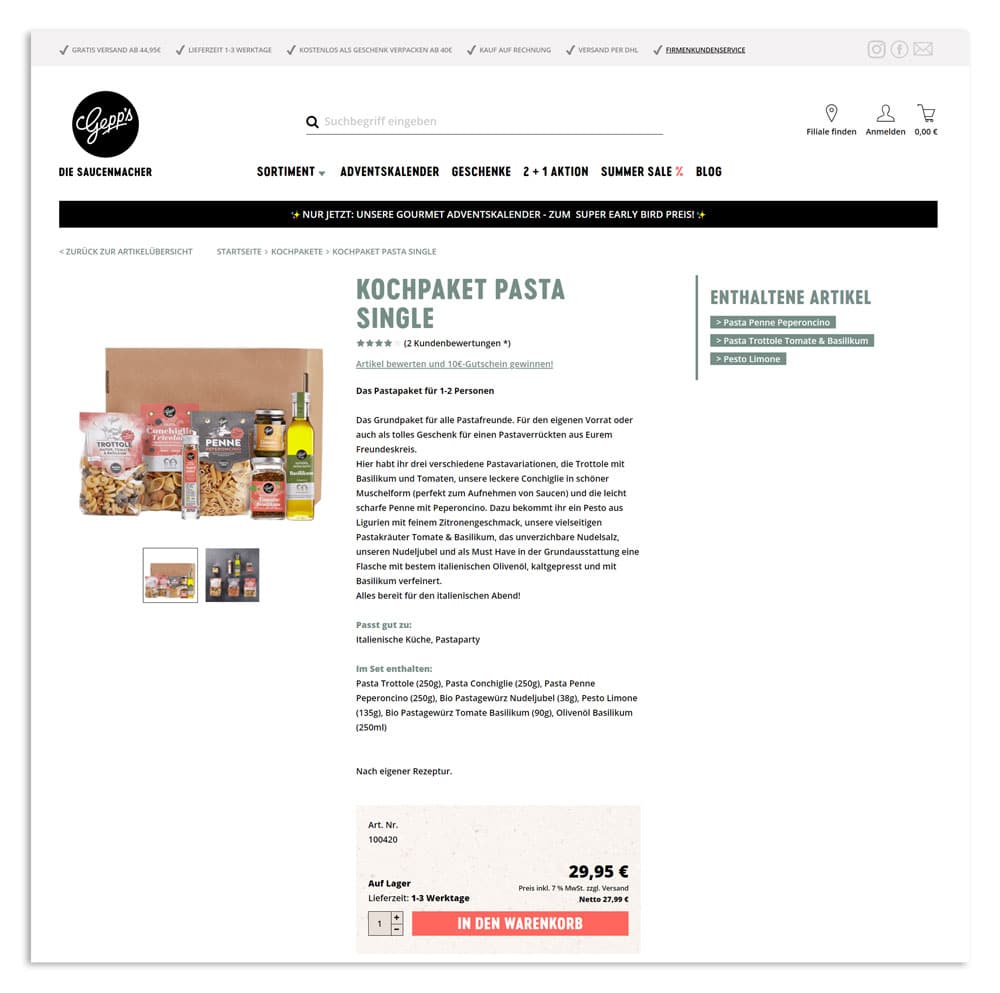
In Gepp's online shop, customers can order complete cooking packages consisting of various pasta products, for example.
(Source: Screenshot from gepps.de)
Product bundles are ideal as part of your cross-selling strategy, as they allow you to offer your customers related but not necessarily related products at the same time without having to advertise them separately. Product bundling can also be beneficial in the area of upselling, i.e., offering an upgrade in terms of quality, novelty, size, etc. Once you have already drawn your customers' attention to one of your products, it is easier to offer them a more suitable and, at the same time, higher-priced version.
Stay up to date on personalization: Sign up for the Epoq newsletter.Sign up now!
Product bundling is also relevant for category management, where you group products into individual product categories to make your offering clearer for your customers. You can expand this marketing tool with another touchpoint by creating new product categories through product bundles.
Bundled offers are beneficial for everyone involved. In this section, you will find arguments in favor of product bundling.
Product bundles offer many advantages for customers. When they purchase one item, they receive several products that complement each other and/or are perceived as a coherent whole. When it comes to everyday items or clothing, customers know they will have to buy something again sooner or later – so why not do it now? And if the price of the product bundle is lower than the price of the individual products, customers also save money, even though they spend more overall than they intended.
Carefully curated product bundles reduce the effort involved in searching and ordering, saving valuable time. This in turn has a positive effect on your store's bounce rate and strengthens customer loyalty.
If you use AI technology to analyze individual customer needs, customers also benefit from personalized product recommendationsthat you can use as part of product bundles and that can be included in their composition.
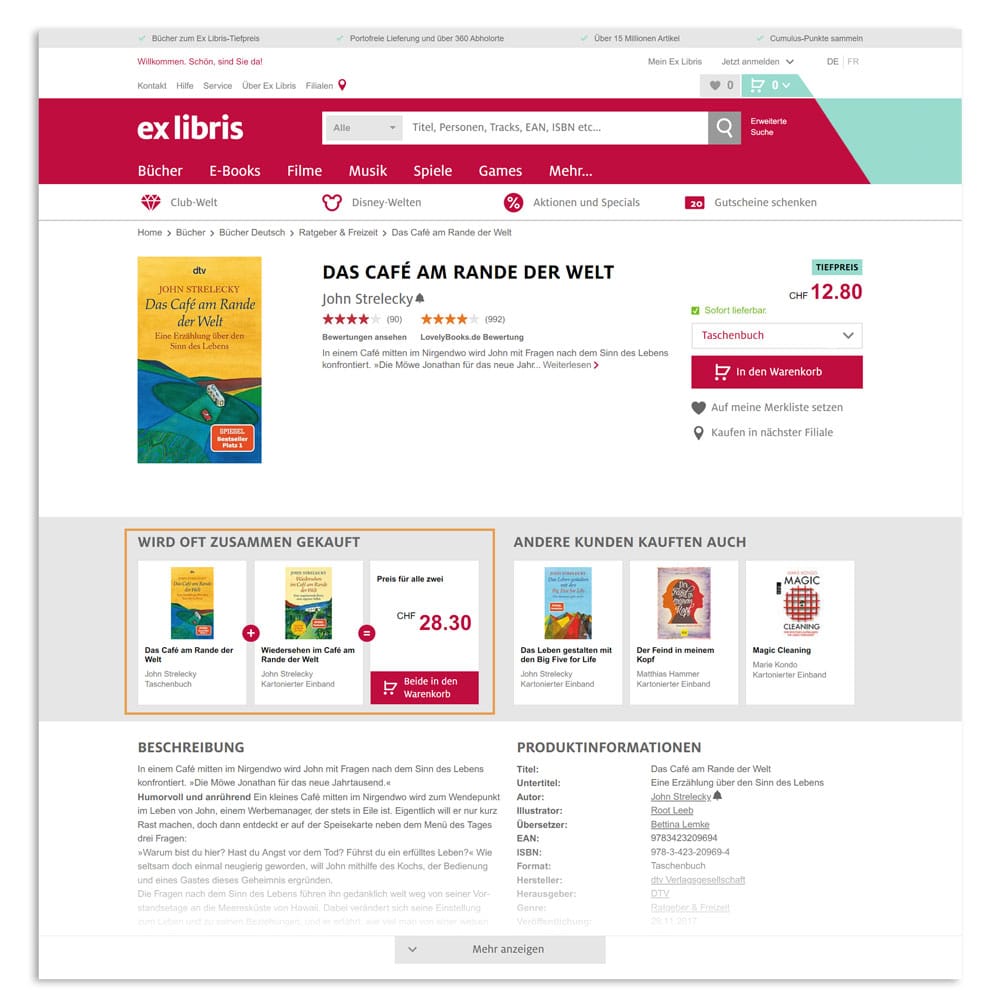
Ex Libris recommends bundles to shop customers in the style of "Frequently bought together," e.g., consisting of two books from the same series.
(Source: Screenshot from exlibris.ch)
As a seller, you also benefit from product bundling in your online shop: when your shop customers buy more products per session, the value of individual orders increases, and with it your total sales. The simplified sales process offered by product bundles allows you to tap into untapped potential at checkout.
Another advantage concerns your marketing activities, because bundle offers allow you to market several products at once, thereby saving costs. You can also reduce shipping and packaging costs in this way, as you can send more items in a single shipment.
In addition, product bundles ensure rotating inventory, as you can combine unknown or less popular products with more popular ones. This creates space in the warehouse and offers the opportunity to raise awareness of previously slow-selling products or introduce new products.
Product bundles also add value for you as a shop operator in terms of customer loyalty. Because if your customers can order affordable product packages tailored to their needs quickly and easily, they are much more likely to remain loyal to your shop. Putting together product bundles is therefore another important building block in creating a personalized shopping experience. Would you like to find out what other measures you can take to strengthen customer loyalty? Then take a look at our blog article on after-sales measures.
Despite all the advantages mentioned, there are still a few points to consider in order to effectively place product bundles in your online shop. Here you will find the most important information and tips for generating more sales through product bundling.
Despite all the euphoria, customers should perceive product bundling as a one-time opportunity or an exception specifically for them, not as an attempt to get rid of slow-moving items. If you offer product bundles too often, your shop visitors will no longer see them as an exclusive offer. Effective one-to-one marketing also allows you to show them only relevant content, increasing the feeling that they are being catered to individually.
When creating subadditive bundles, you should make sure that the selling price of the products in the package is lower than the combined price of the individual products, otherwise potential buyers may feel they are getting a bad deal.
Whether subadditive, mixed, or pure bundling—with these practical tips, you can successfully implement your product bundle strategy:
Customers like to have choices. So give them the option to choose from more than one bundle or even put together their own.
In addition to quality and usefulness, the price of a product is one of the most important deciding factors. Product bundles are perfect for savings offers, which is why you can and should clearly communicate the cost savings.
By personalizing bundle offers, you can target customers who already have a history with your company and present them with offers tailored to their individual preferences. You can use a recommendation system to display bundle recommendations. Product bundles are also perfect for encouraging potential customers to place their first order, as they promise lower prices and a wide variety of products to try out.
Strategically leverage your range of product bundles: Suitable touchpoints include the product detail page, the shopping cart layer, or a personalized newsletter.
Stay up to date on personalization: Sign up for the Epoq newsletter.Sign up now!
The easier it is for customers to find product bundles in your shop, the more often they will take advantage of such offers. Create a separate filter category for product bundles and make it easier for customers to find the best deal.
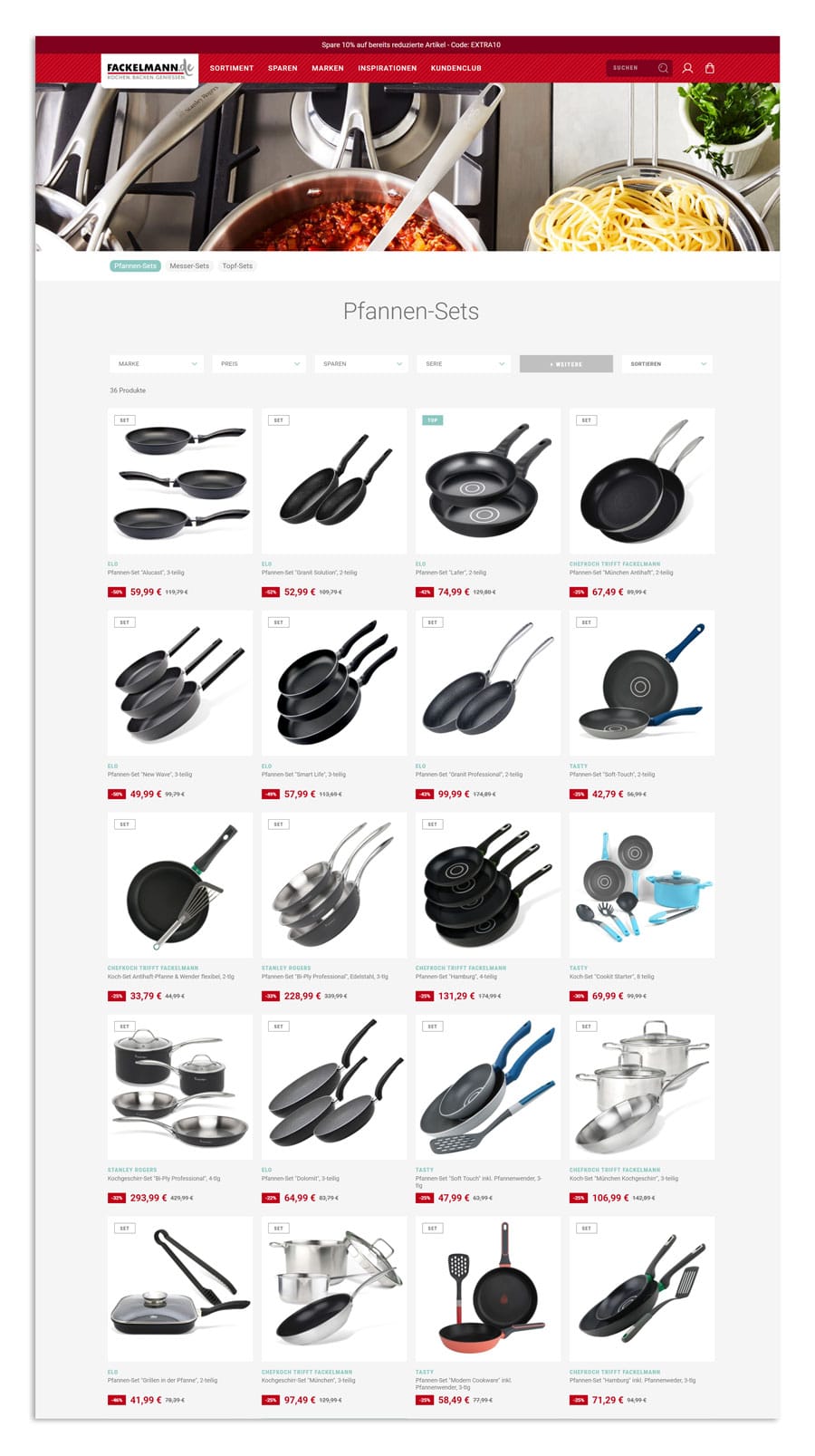
Fackelmann even offers its own "pan sets" category, which customers can navigate to via the menu and discover various sets at a glance.
(Source: Screenshot from fackelmann.de)
By putting together product bundles, you increase the average basket value and thus your sales, save on advertising, shipping, and packaging costs, and offer your customers the opportunity to obtain affordable products that are tailored to their individual needs. This can lead to greater customer loyalty. At the same time, however, you should make sure to use product bundles in a targeted and conscious manner to avoid giving the impression of being a low-cost provider.
The term product bundling refers to the simultaneous sale of several products or services that have been combined into a single sales unit. To do this, two or more similar or related products are combined into a bundle and offered for sale at a total price.
A distinction is made between subadditive bundling, where the package price is lower than the sum of the individual products, additive bundles, where the prices of the individual products are added together, and superadditive bundles, where the price of the package is higher than when purchasing the individual products. In pure bundling, the products included are only offered together in a package, whereas in mixed bundling, the products can be purchased both in a bundle and individually.
By offering product bundles, shop operators increase their average shopping cart value and generate more sales. They also save on marketing costs, as bundle offers allow them to market several products at once. Shipping and packaging costs are also reduced, as more items can be sent in a single shipment. Product bundles can also increase customer loyalty: when customers can quickly and easily order affordable product packages tailored to their needs, this can reduce the bounce rate.
Popular bundle offers include cosmetic products, which retailers offer as sample packs with complementary items from a product line; kitchen utensils such as pans or pots, which are combined in sets of different sizes or with matching items such as pan lifters, etc.; or everyday clothing items such as underwear, socks, etc., which are offered in value packs.
It is important to highlight the benefits for the customer. Product bundles are perfect for savings offers, and this should also be communicated in your advertising. Product bundles should be presented to customers in a strategically advantageous way: suitable touchpoints include the product detail page, the shopping cart layer, or a personalized newsletter. To further increase the reach of bundle offers, it is advisable to create a separate filter category for product bundles. By personalizing the bundles, each customer receives offers that are tailored to their needs and can thus be addressed individually.
Are you interested in personalization strategies in e-commerce?
In our case study, you can find out how Outletcity Metzingen increased sales in its online shop by 5.04%.

You are currently viewing placeholder content from HubSpot Embedded Content. To access the actual content, click the button below. Please note that doing so will result in data being shared with third-party providers.
More InformationYou are currently viewing placeholder content from HubSpot. To access the actual content, click the button below. Please note that doing so will result in data being shared with third-party providers.
More InformationYou are currently viewing placeholder content from HubSpot Meetings. To access the actual content, click the button below. Please note that doing so will result in data being shared with third-party providers.
More Information