
E-book – Personalization in E-commerce
In this e-book, you will learn why personalization is important in e-commerce and what the term personalization actually means.

You've just finished watching the latest season of your favorite series on Netflix, and the streaming provider immediately suggests another series. You take a look and find it just as exciting. This is an outstanding example of hyper-personalization. And Netflix isn't the only one enjoying success with this marketing strategy. Use hyper-personalization for your online shop to increase your sales and customer loyalty. Find out how the concept works and what advantages it offers.

Here'swhatyou can expect to find in this blog article:
Hyper-personalization – a definition
Personalization vs. hyper-personalization
How hyper-personalization works
Core elements of hyper-personalization
Advantages of hyper-personalization in e-commerce
Long-term reduction in marketing costs
Improvement in ROI
Maximization of sales
Improved customer experience
Increased brand loyalty
Gain an edge over the competition
Well-known companies are focusing on hyper-personalization
Amazon
Starbucks
Spotify
Netflix
Conclusion: Hyper-personalization is a decisive competitive factor
Frequently asked questions about hyper-personalization in e-commerce
Hyper-personalization is a marketing strategy that interprets customers' intentions in detail and tailors content to them. It reaches shop visitors on a much deeper level than the first stages of personalization, as the respective content is not only adapted to the individual preferences of a specific user, but also to their intentions and buyer type, and this in real time: the right product at the right time and at the right touchpoint. This is why it is also referred to as 1:1 personalization. It is also often referred to as one-to-one marketing, as this refers to 1:1 personalization or hyper-personalization. An example of this is a newsletter with 1:1 personalized cross-selling recommendations, in which the header image shows a product from the customer's favorite brand, for example, and reaches the customer at the right time.
Stay up to date on personalization: Sign up for the Epoq newsletter. Register now!
The aim is to use 1:1 personalization to attract customers' attention and thus generate competitive advantages. This plays a particularly important role in e-commerce, because there are a large number of competitors offering similar products and services.
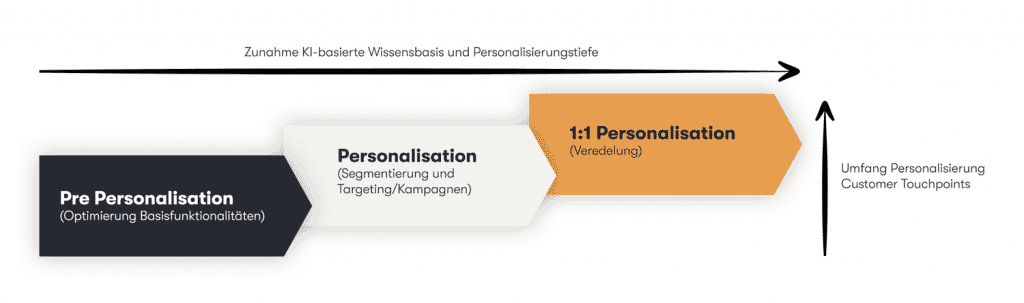
With each level of personalization, the depth of personalization and the scope of personalized customer touchpoints increase.
(Source: Own representation)
Personalization in e-commerce has been a familiar concept for many years: emails that address customers personally and newsletters with personalized content are among the most important strategies for email marketers to increase engagement rates. Personalized product recommendations and search results are also important pillars for higher sales in online retail. To offer this type of content, you need pseudonymized data on your customers' click and purchase behavior. Artificial intelligence helps you evaluate this data. This allows you to get to know the wishes, likes, and preferences of your shop visitors and respond accordingly.
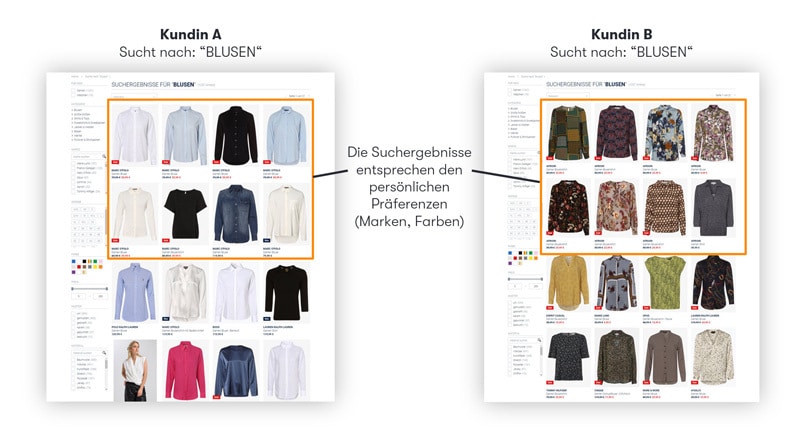
Personalized search results are one example of how to engage customers individually with relevant content.
(Source: Own representation with screenshots from peek-und-cloppenburg.de)
Hyper-personalization is a further development of personalization. Instead of using historical data for product recommendations, for example to display recommendations such as "recently viewed" or products of the learned size, you collect data about your customers' purchasing behavior, location, and preferences in real time. In addition to the personal preferences of shop customers, hyper-personalization also takes into account the user's intention (e.g., a customer wants to browse) and the type of buyer (e.g., bargain hunter, bulk buyer, etc.). With the help of artificial intelligence and machine learning, as well as data from IoT (Internet of Things) devices where applicable, you can analyze this information to identify patterns and correlations.
The results then serve as the basis for highly personalized recommendations and offers, which are automatically displayed to the respective customers. The PAYBACK points system, for example, accesses the location of app users to show them coupons for nearby stores.
Hyper-personalization thrives on data about purchasing behavior, individual preferences, and interests, as well as the calculation of intent, user type, and preferences based on real-time interaction between the website and the user. For its successful recommendation system, Amazon analyzes order history, all products that customers have added to their shopping cart or rated positively or liked, as well as products that other customers have liked and purchased. From this, artificial intelligence ultimately determines suitable recommendations for the respective shop visitors.
State-of-the-art technologies are needed to analyze the huge amounts of data. With the help of machine learning, artificial intelligence can make increasingly accurate predictions. IoT-enabled devices also provide support: the Malibu Rum brand, for example, has developed a smart bottle that works with NFC technology. Customers simply hold their smartphone up to the bottle to interact with the company in the store or at home.²
Due to current data protection regulations, not all types of individual customer data may be collected. However, even pseudonymized facts and figures can help to develop hyper-personalized offers.
Three factors are extremely important for hyper-personalization to work successfully in your online store: engagement, relevance, and trust. We will take a closer look at these three aspects below:
One-to-one marketing offers you numerous advantages, which we explain here.
Targeted measures that are precisely tailored to the needs of your customers reduce your marketing costs in the long term. This helps you avoid wastage due to inaccurate targeting of your audience.
Furthermore, hyper-personalization improves your return on investment. The conversion rate increases, leading to higher sales. Your initial costs are thus offset.
You recommend exactly the products and services your customers need. This means they don't have to click through countless suggestions, but instead receive a small, refined selection tailored to their interests. This reduces the return rate and also increases your sales.
According to a study by Epsilon, 80% of customers are more likely to buy something when brands offer them personalized experiences.⁴ And 92% of marketing experts say that customers and prospects actually expect this kind of individualized user experience.¹ Since hyper-personalization responds even more strongly to customer needs, it significantly improves the customer experience. Customers feel that they are understood and met exactly where they are right now.
Positive experiences with your online store increase customer satisfaction and build trust. These two factors are essential for long-term customer loyalty and brand loyalty. With hyper-personalized content, you can further increase the satisfaction of your store visitors and ultimately turn them into loyal regular customers.
Stay up to date on personalization: Sign up for the Epoq newsletter. Register now!
Last but not least, one-to-one marketing gives you a competitive edge over your e-commerce rivals. With so many providers on the market, products and services are interchangeable. That's why customers value service and quality, as well as the feeling that their individual needs are being met.
Some well-known brands have been using the concept of hyper-personalization very successfully for several years. These include Amazon, Starbucks, Spotify, and Netflix, for example. Here, we explain how they specifically engage their customers with individualized content:
E-commerce giant Amazon has perfected hyper-personalization. The company recommends suitable products to its customers across various channels, generating around a third of its revenue in this way.⁵ The data analysis algorithms are based on a process called "item-to-item collaborative filtering."With the help of deep learning technology, artificial intelligence recognizes patterns in user behavior and can thus make decisions about possible product recommendations.
Starbucks collects a wealth of real-time data on customer behavior and preferences via its app-based loyalty program. With the help of AI, the coffee shop brand delivers hyper-personalized special offers in the form of in-app and push notifications. In addition, all customers can enjoy a personalized user interface. With this one-to-one marketing approach, Starbucks is significantly increasing customer loyalty.
Hyper-personalization at Spotify means daily and weekly playlists that are tailored to individual users. This allows customers to continually discover new songs that match their preferences. As a global company, the streaming provider also offers playlists in various regional languages and separate social media channels for key markets, such as Spotify India.
Netflix's recipe for success is hyper-personalization: the user interface for each individual account looks different and is based on the user's individual preferences. The streaming provider asks about personal preferences as soon as an account is created. The algorithms can then immediately suggest suitable films, series, and shows based on the answers.
Netflix not only analyzes what users watch, but also when and for how long. Based on this, it sends a push notification to smartphones at the optimal time, for example, to let users know that the new season of their favorite series is starting.
With the help of hyper-personalization, you can recommend the right products and services to your customers at the optimal time. Your shop visitors will appreciate this individualized service and enjoy shopping in your online store. This will help you retain your customers in the long term, reduce your costs, and, last but not least, increase your sales. It will also set you apart from your competitors. The big brands have shown that hyper-personalization is a key factor in success.
Sources: ¹ HubSpot, ² Marketing Insider Group, ³ Accenture, ⁴ Epsilon, ⁵ intomarkets
Hyper-personalization is a marketing strategy that aims to draw customers' attention to a company through individual product recommendations and services. The content is tailored to the specific user in terms of preferences, intentions, and buyer type.
Successful hyper-personalization requires large amounts of real-time data on click and purchase behavior as well as location. This data can be analyzed with the help of artificial intelligence and machine learning. Modern technologies are capable of recognizing patterns and correlations, from which hyper-personalized content such as recommendations or search results can be derived.
Customer engagement, relevant product recommendations, and trust in the use of collected data are core elements of hyper-personalization.
Hyper-personalization in e-commerce offers numerous advantages: Among other things, you reduce your marketing costs in the long term, increase your sales, strengthen brand loyalty, and gain an advantage over your competitors.
Among the best-known brands that have implemented hyper-personalization very successfully are Amazon, Netflix, Starbucks, and Spotify. They recommend products and services to their customers on a highly individualized level that are optimally tailored to their needs.
Would you like to learn how you can use AI to provide personalized service to store visitors?
Then get our e-book now!

You are currently viewing placeholder content from HubSpot Embedded Content. To access the actual content, click the button below. Please note that doing so will result in data being shared with third-party providers.
More InformationYou are currently viewing placeholder content from HubSpot. To access the actual content, click the button below. Please note that doing so will result in data being shared with third-party providers.
More InformationYou are currently viewing placeholder content from HubSpot Meetings. To access the actual content, click the button below. Please note that doing so will result in data being shared with third-party providers.
More Information