
How-To | Data Enrichment – Make Informed Decisions (#EpoqPXD22)
In this slot, the speakers will present various solutions for data management.

95 percent of Germans believe it is important for retailers to know their interests and preferences.¹ You should therefore address your customers personally and directly. To do this, you need new and enriched data that allows you to make targeted decisions based on facts and trends, rather than relying solely on gut feeling or speculation. The art of integrating new data into your own database is called data enrichment. This enrichment process makes your data more useful and insightful and is an important success factor for companies operating in a modern data-centric environment. In this article, you will learn about the other benefits of data enrichment and how you can use it.

Here'swhatyou can expect to find in this blog article:
Data enrichment: The importance of data enrichment
Components of data enrichment
Integration into your own database
Benefits of data enrichment in e-commerce
Requirements for successful data enrichment
Data enrichment: Use cases for successful implementation in e-commerce
Enabling omnichannel commerce
Preventing abandoned purchases
Minimizing returns
Avoid out-of-stock situations and inventory backlogs
Maximizing high-margin sales
Use 1:1 personalization
Conclusion: Data enrichment allows you to get more out of your data.
Data enrichment basically refers to the process of merging new data from third-party sources into your own database. Enriching your own data with external data increases the value of the data. When it comes specifically to enriching customer data, this is referred to as customer data enrichment, while enriching product data is called product data enrichment.
Data enrichment allows you to put information into a new context and give it structure. From there, you can derive exciting insights and use them in e-commerce to improve the customer experience and generate higher sales. A solid database is therefore an important element for the development of AI and thus also for personalization in e-commerce. This is because new data sources are a prerequisite for and provide inspiration to make AI technology even more powerful.
Data enrichment encompasses three core aspects:
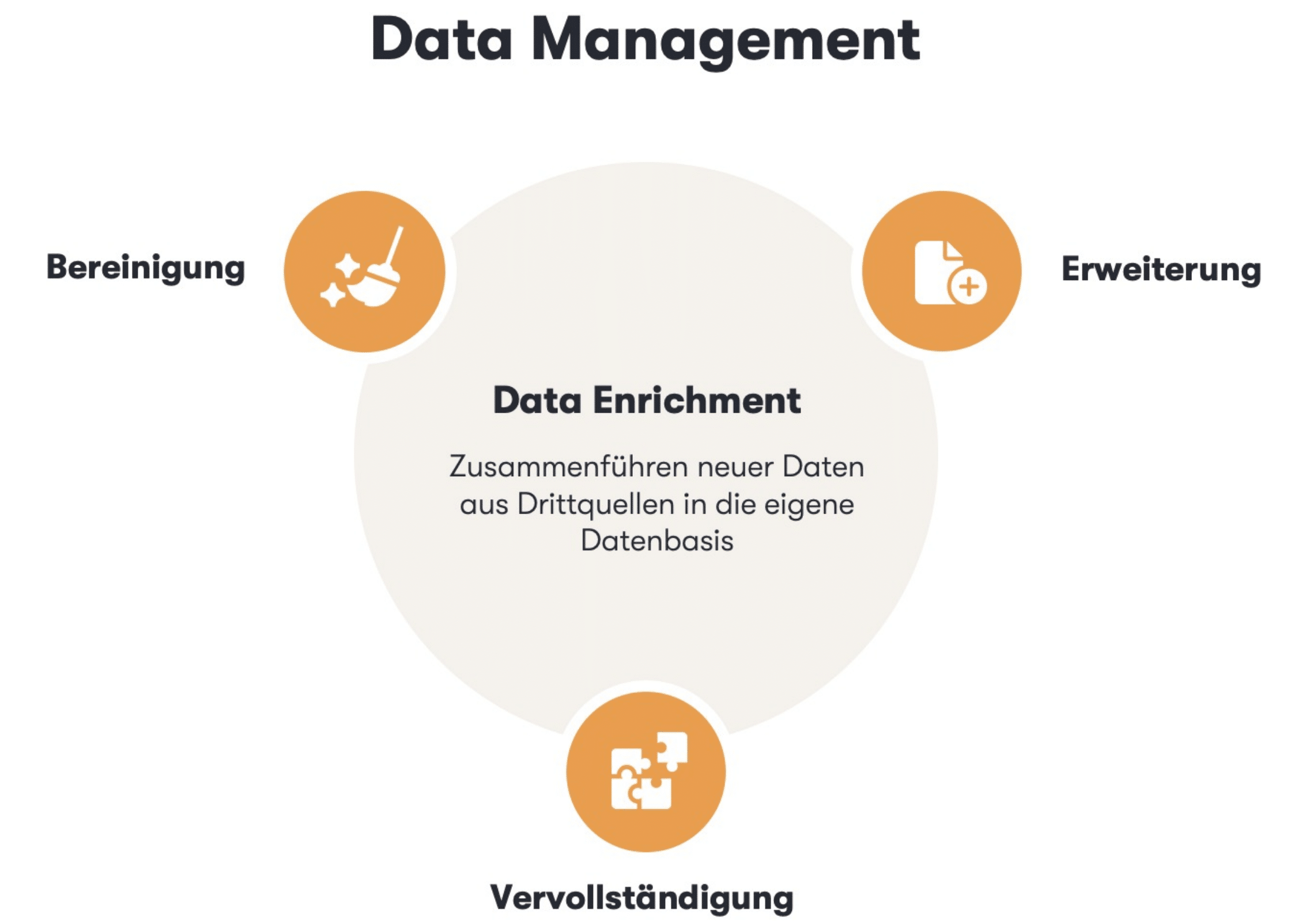
Cleaning, expanding, and completing your data are the central aspects of data enrichment. (Source: Own representation)
Data enrichment also poseschallenges for your own database. First of all, new data is simply added and can then be used as KPIs or features in the service applications. If, for example, it turns out that the new KPIs and features are better, they should replace the old ones. In addition, you should delete data that is no longer needed in order to conserve resources and ensure data protection.
Ideally, adding and removing data should not make the schema of your own database more complex. Instead, the new data should be easy to insert into the existing schema and used in the applications without much effort. If this is not the case, you should consider changing your own schema, which would of course involve more effort.
The enriched data can be crucial to your success and offers you many advantages:
With the help of data enrichment, you can make profitable use of existing information, win over your customers with personalized offers, and set up effective marketing tailored to specific target groups.
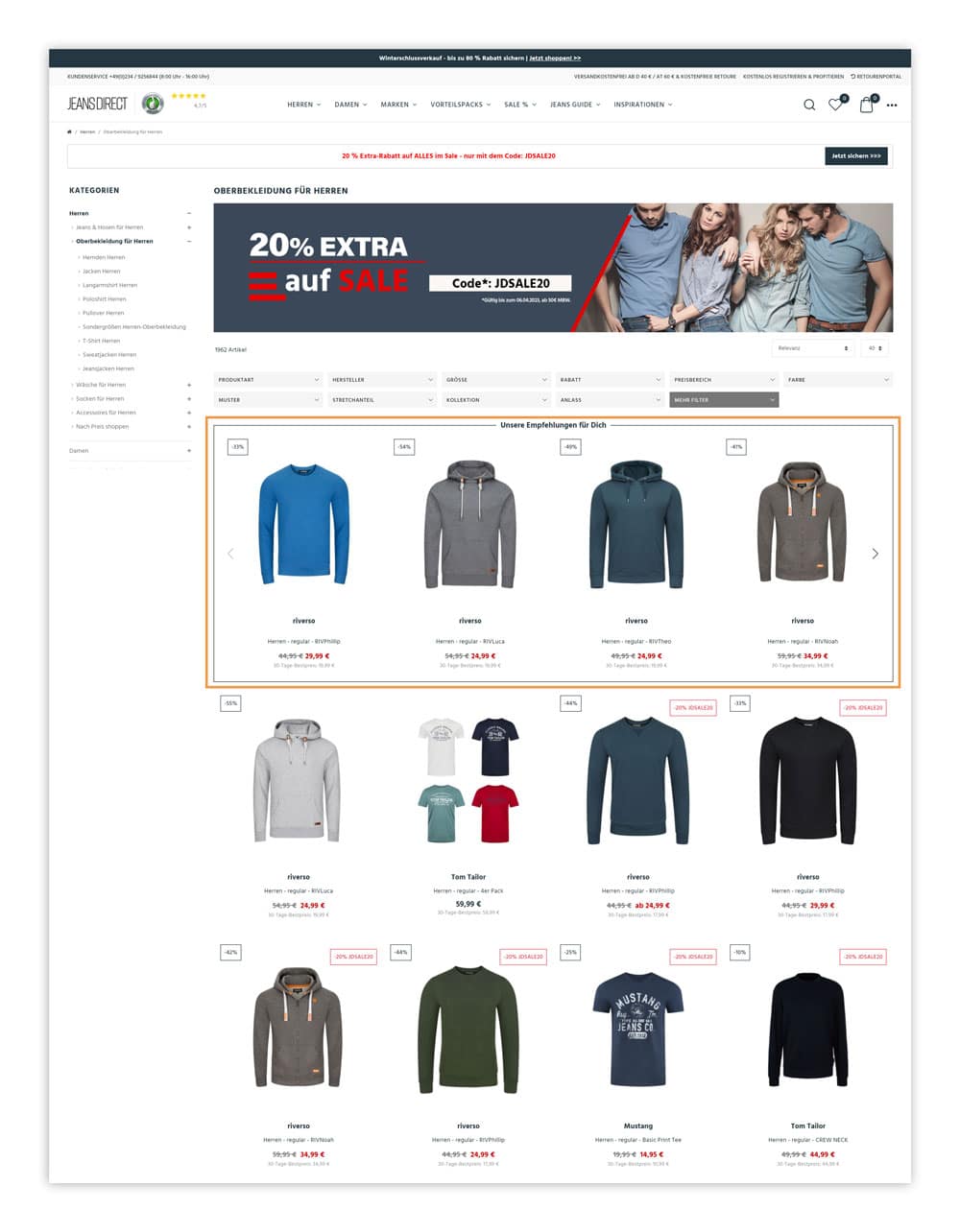
In the Jeans Direct online shop, for example, customers are targeted with personalized product recommendations.
(Source: Screenshot from jeans-direct.de)
A major challenge for many online shops when it comes to data enrichment is that the existing data is left to languish in its silos. This means that the data is not connected, but stuck in isolated data silos. Often, the necessary infrastructure to merge data is also lacking. Other problems include conflicting metrics resulting from inconsistent silo data, a lack of customer understanding and thus incomplete customer profiles for a 1:1 marketing approach, and a lack of data-driven processes and access to data, which means that there is no data culture .
The fundamental prerequisite for data enrichment is integrated data in the form of a solid and reliable database. It is therefore crucial to create a data infrastructure as a starting point for data enrichment. To do this, you extract all data from various systems such as your ERP system, your web analytics tools, your marketing data, product data, etc., and consolidate it in a data warehouse. There, the data is standardized and structured using a data model. The whole thing forms the basis for making holistic decisions. The database can then be used to transfer data to third-party systems and, for example, for email marketing in e-commerce. Transactional data can also be used to optimize and personalize the user experience in the shop.
Use data enrichment to offer your customers an even better shopping experience. E-commerce offers numerous starting points for the successful use of data enrichment. These examples show the possible range:
If users shop both in a brand's physical store and online shop, both channels can be connected. This is because relevant events also take place outside your shop that can serve as a supplementary data source. With the help of customer loyalty programs such as a bonus program or a customer card , you can collect information in brick-and-mortar stores and use it profitably in your online shop thanks to data enrichment.
In-store purchases are an example of relevant events outside the shop and offer you the chance to complete the most valuable type of event – namely the buy event. It is valuable in the sense that it provides AI with the most relevant information for personalized recommendations, enabling you to deliver tailored recommendations. For example, you can provide your customer with online styling suggestions that match the shirts she last purchased offline. This link optimizes the shopping experience, strengthens brand awareness, and ultimately brand loyalty.
In e-commerce, it's all about preventing abandoned purchases. Imagine if you could remove obstacles from the checkout process step by step. For example, by presetting the default address or preferred payment method based on previous purchase behavior data. This significantly reduces the risk of abandoned purchases.
Returns are the weak point of every online retailer. Enriched data helps you avoid them and minimize your return rate. The return rate is an important KPI because sales are directly dependent on it. Return data is an important part of purchasing behavior and can provide you, as an e-commerce manager, with information about frequently returned products and reasons for returns, for example.
The product recommendation system can benefit from these new sources of information, as products that are frequently returned should certainly be recommended less often. This means you can exclude goods that are frequently returned from campaigns and exclude items with high return rates from your recommendations. For new customers , you can also feature top sellers with low return rates in your recommendations. In addition, data enrichment allows you to flexibly display information on product detail pages that can help prevent returns, such as details about the fit of a pair of pants. You can enrich this additional information based on the reasons for returns.
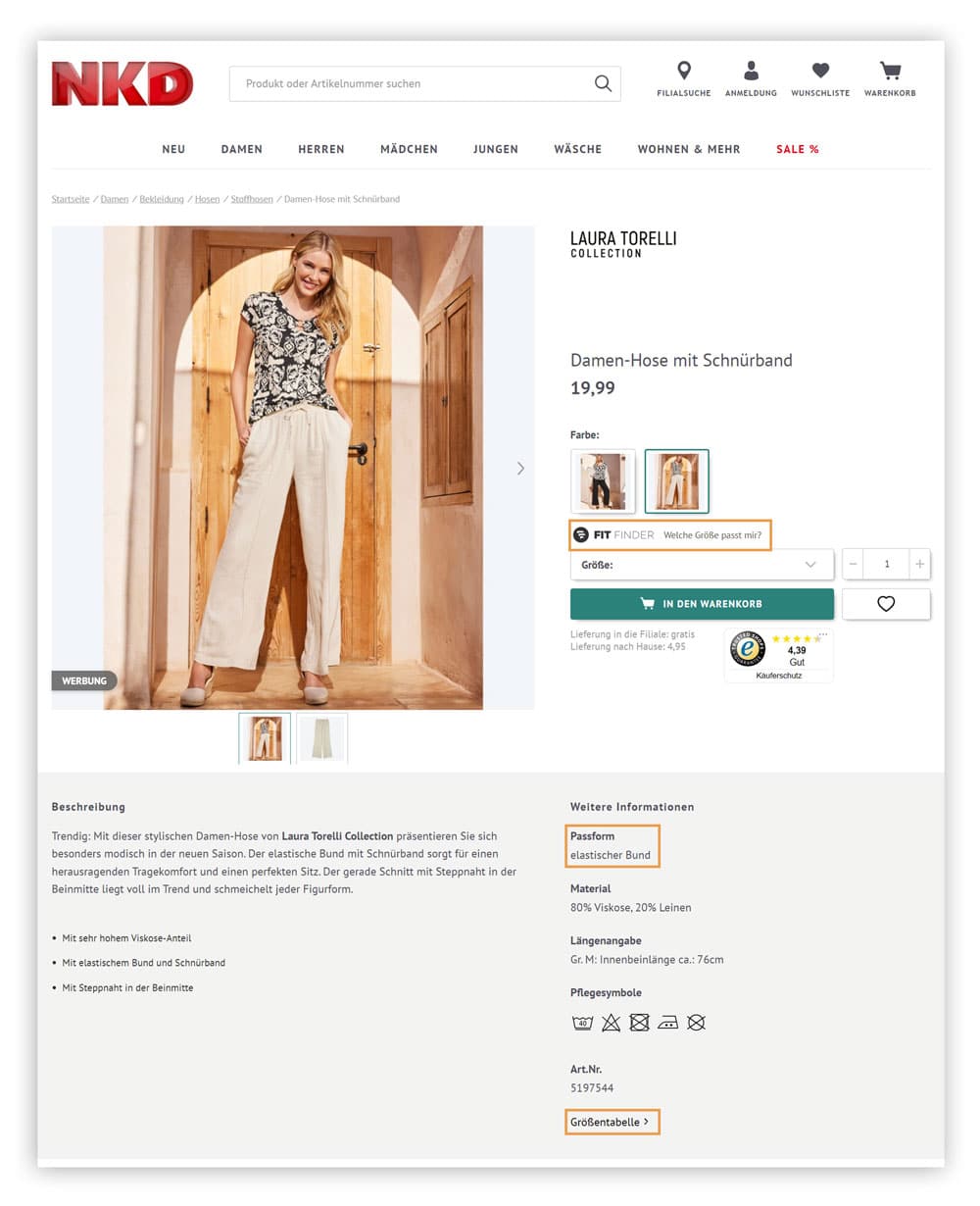
NKD aims to prevent returns by providing information on fit, a size chart, and a size finder directly on the product detail page.
(Source: Screenshot from nkd.com)
If you generally notice a high return rate in certain categories of your shop, you can counteract this by using a product advisor. This also requires data enrichment, or more precisely, an enrichment of product data so that shop customers can select the features they want. In the case of a luggage advisor, as offered on worldshop.eu, the required features would be, for example, what type of wheels a suitcase has, what compartments or what fastenings the luggage has. Especially when the product range is somewhat more specialized, expanding the product features in the sense of data enrichment makes a lot of sense.
Each of the three aspects of data enrichment can significantly improve the quality of such an online product advisor. For example, cleaned data prevents items from being displayed even though they do not match the current feature selection. With the help of completion, you prevent the opposite from happening, namely that suitable items are not displayed. Finally, expanding the data brings the product advisor to life. This gives the customer enough options to choose from, and the features really help them.
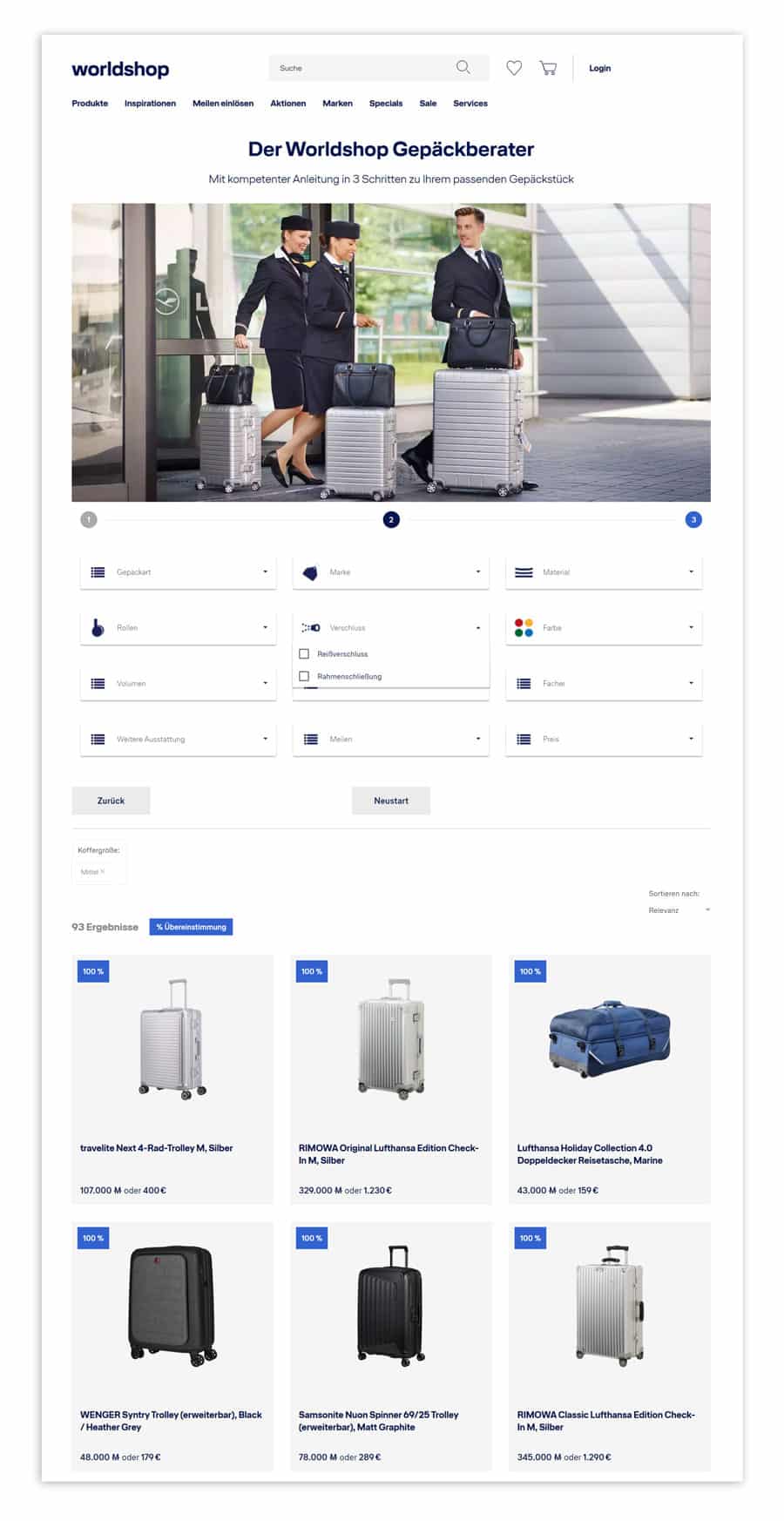
The Worldshop luggage advisor offers shop customers many features that make product selection easier.
(Source: Screenshot from worldshop.eu)
You can find out more about how personalization can help you avoid returns in our blog article on this topic.
Data enrichment also helps you avoid out-of-stock situations by determining stock range based on factors such as current stock levels and historical order and return behavior. This allows you to hide certain products in your shop that may not be delivered on time.
You can also use data enrichment to identify slow-moving items. This allows you to boost sales of these products and avoid stockpiling.
Data enrichment also enables you to identify high-margin products and thus maximize your sales. To do this, your data must be enriched with information such as the product's contribution margin, marketing costs, or transactional costs.
Also consider the interests of your shop visitors and address each individual customer with 1:1 personalization. Based on previous transactions and interests, customers can be segmented or addressed individually. Use the enriched data in email marketing, for example, to personalize newsletters more effectively. Instead of just using a personal greeting with their first name, you can even customize the entire content of the email, for example with recommendations for their favorite brand, preferred colors, or styles. Information about your customers' interests can also be used for recommendations in your online shop. This will increase the average order value and your sales.
Stay up to date on personalization: Sign up for the Epoq newsletter.Sign up now!
If you would like to learn more about how to tailor product data in your online shop to the needs and pain points of your customers, as well as how to prepare and enrich your product data feed in order to optimize search results or display relevant recommendations in your shop, we recommend reading our blog articles on these topics.
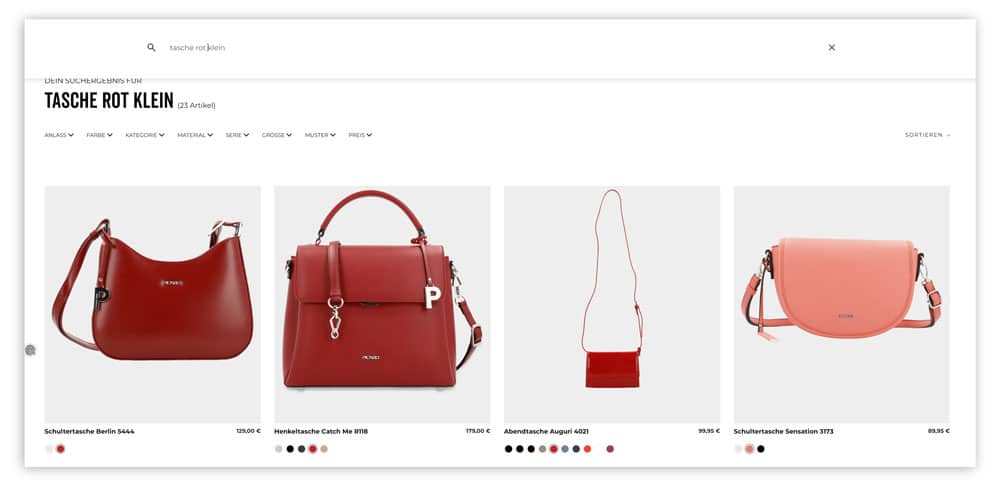
Thanks to an optimized search function, customers in the PICARD online shop can also obtain relevant results for search term combinations they enter.
(Source: Screenshot from picard-fashion.com)
You can get support with data enrichment and other topics related to data management, infrastructure, and administration from various enrichment services, which offer different levels of support depending on your needs. For example, you can transfer your existing data to a service that validates it and then enriches it with suitable characteristics. There are also various software providers and tools that offer you the best possible support for data enrichment. Service providers can also assist you with the complete implementation of data enrichment in your online shop and support you in preparing your existing data and introducing suitable tools.
We would like to briefly introduce two providers specializing in data-related topics as examples:
minubo is an example of a turnkey, all-in-one business intelligence solution that was developed specifically for e-commerce. The core of this complete solution is to bring together all the data that is scattered throughout the company, thereby creating transparency and a good basis for holistic decisions and further processing in third-party systems.
As a digital operations platform, Actindo offers not only a PIM system for data management and control, but also a DataHub, which ensures that all data flows smoothly through the various modules and external IT systems of the companies. The flexible data model makes it possible to map and transform complex and varying data and transfer it to other modules and external systems – all fully automated.
Addressing customers personally and individually and providing a unique shopping experience can give your online store a significant competitive advantage. Data enrichment helps you enrich your data sets so that you can draw conclusions about the interests and needs of your visitors. This allows you to consistently tailor your customer approach and make targeted decisions. Data enrichment also offers major advantages in other areas—whether it's reducing return rates, preventing abandoned purchases and stockpiling, or increasing sales of high-margin products—with data enrichment, you can get the most out of your data. To ensure the effectiveness of your measures, you should continuously optimize your campaigns.
Source: ¹ Accenture
Data enrichment refers to the process of merging new data from third-party sources into your own database. Data enrichment consists of three aspects: cleansing, expanding, and completing.
Data enrichment offers you the opportunity to better understand your customers, place information in a broader context, and make targeted decisions based on the enriched data.
One challenge, for example, is that existing data is often stored in isolated data silos and is not connected. In addition, the infrastructure required to consolidate the data is often lacking. Contradictory key figures, a lack of customer understanding, and a lack of data-driven processes can also pose problems.
The fundamental prerequisite for data enrichment is integrated data in the form of a solid and reliable database and thus a data infrastructure that serves as the starting point for data enrichment.
In the online shop, you can use enriched data to tailor content to individual visitors. This allows you to display ads and product recommendations based on their interests. Or you can influence purchasing and visitor behavior by removing obstacles in the checkout process, for example by presetting user preferences. You can also use enriched data to specifically avoid returns, abandoned purchases, or stockpiling, as well as to maximize high-margin sales.
Would you like to learn more about this topic and find out how you can exploit the full potential of your data?
Watch our webinar recording!

You are currently viewing placeholder content from HubSpot Embedded Content. To access the actual content, click the button below. Please note that doing so will result in data being shared with third-party providers.
More InformationYou are currently viewing placeholder content from HubSpot. To access the actual content, click the button below. Please note that doing so will result in data being shared with third-party providers.
More InformationYou are currently viewing placeholder content from HubSpot Meetings. To access the actual content, click the button below. Please note that doing so will result in data being shared with third-party providers.
More Information