
E-book – The Comprehensive recommendation system Guide
Learn more about recommendation strategies, areas of application, personalization, and success factors for product recommendations, as well as successful use cases in this guide.

Onsite merchandising is about showcasing products directly in the online store—so that they are not only seen, but also purchased. This is becoming increasingly important in the highly competitive e-commerce market. It is no longer enough to simply have a good offer—presentation is crucial. Onsite merchandising can therefore be a key sales driver that increases shopping cart value, boosts conversion rates, and strengthens brand loyalty. But which strategies are effective, and how can you make the most of them for your digital sales space?

Here's what you can expect to find in this blog article:
Onsite merchandising in digital commerce: definition and objectives
The significance of onsite merchandising in e-commerce
Onsite merchandising vs. onsite marketing
The objectives of onsite merchandising
Short-term vs. long-term measures in onsite merchandising
Application and use in e-commerce: Where onsite merchandising works
Home
Product overview pages
Product detail pages
Campaign landing pages
Shopping cart and checkout
Controlling your onsite merchandising measures
Rule logic: Targeted use of visibility
Targeting: From the product to the individual user
Important: Balance between sales promotion and customer experience
4 key questions for your successful onsite merchandising strategy in e-commerce
Conclusion: Increased sales through targeted product presentation
To understand the importance of onsite merchandising for digital commerce, we first need to clarify what it is and what goals the discipline pursues. Only then can shop operators use onsite merchandising effectively to optimize the shopping experience and increase sales in the long term.
Onsite merchandising is a sub-area of e-commerce marketing and encompasses all measures you can take to effectively present products in your online shop in order to positively influence the purchase decision. It is the digital version of typical sales promotion at one of the most important moments of the customer journey: the point of sale.
The core of onsite merchandising is the strategic interplay of:
Onsite merchandising aims to present customers with the right product at the right time in the best possible way in the online shop—tailored, data-driven, and sales-oriented. This makes onsite merchandising crucial for brand management, customer experience, and shopping cart value.
Stay up to date on personalization: Sign up for the Epoq newsletter. Register now!
Although the two terms are often confused, they differ in their focus: onsite marketing forms the overarching framework, while onsite merchandising is a specialized sub-area that focuses on the targeted presentation of products.
Onsite merchandising therefore focuses on products and their optimal presentation in the online shop. The aim is to optimize the purchasing process and increase sales by specifically controlling product ranges, categories, and placements. Typical measures include targeted product placements, customized sorting, highlighting new or high-margin items, product recommendations such as cross-selling and upselling, and product bundles.
Onsite marketing, on the other hand, focuses on target groups and campaigns. It aims to activate visitors, retain them, and encourage them to take a desired action, for example through banners, pop-ups, personalized content, or campaign teasers. These activities are often part of a long-term communication strategy in which content and messages are tailored to the individual visitor.
In practice, however, it is not always possible to strictly separate the two areas. Many measures, such as personalized product recommendations or seasonal campaign placements, can fall under both onsite merchandising and onsite marketing, depending on whether the focus is on product presentation or targeting the target group.
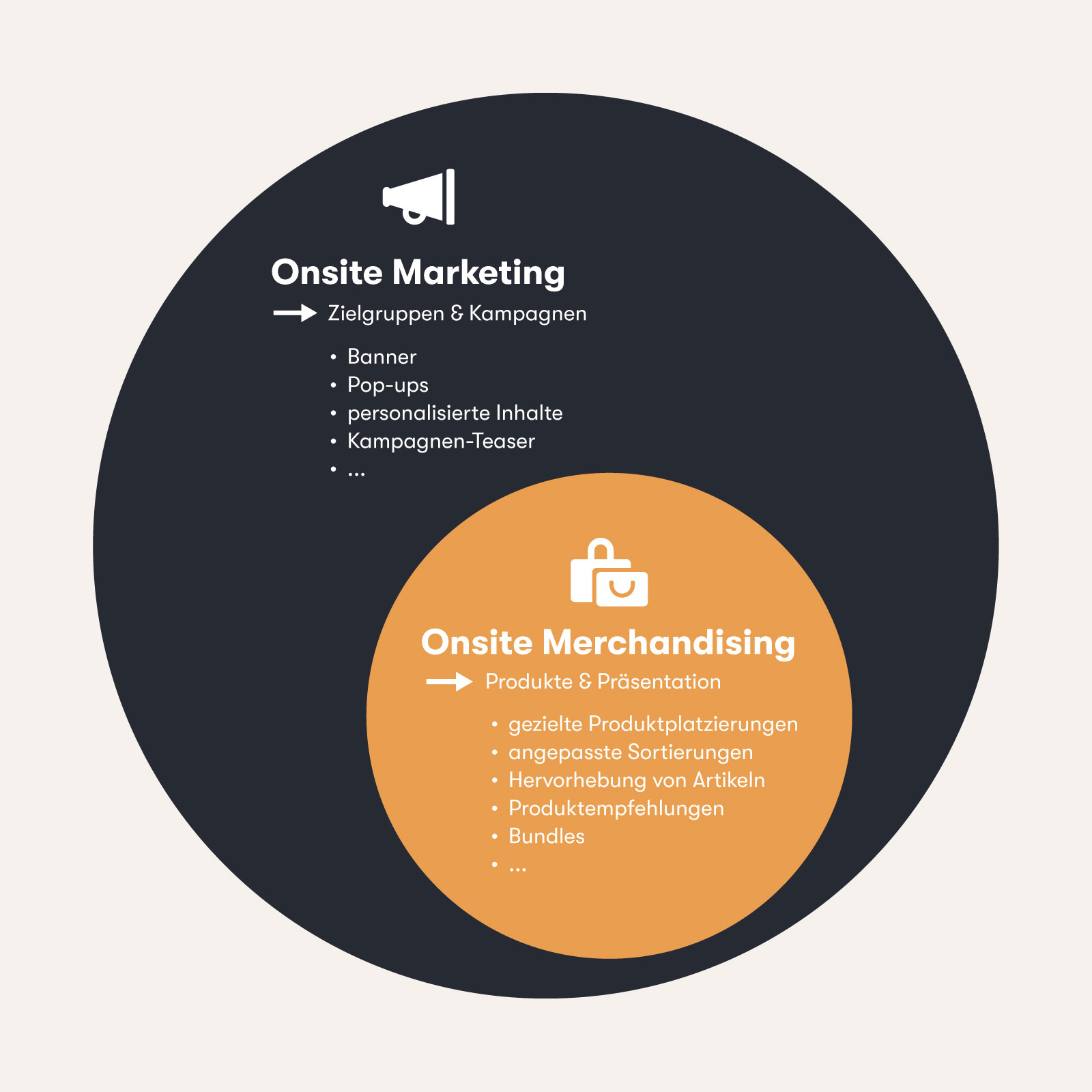
Connection between onsite marketing and onsite merchandising (Source: Own representation)
First and foremost, onsite merchandising should specifically control the shopping experience of store visitors and make it as sales-promoting as possible.
Important goals are:
Successful onsite merchandising combines impulses for immediate purchases with strategies for the sustainable optimization of the product range presentation. It is worth distinguishing between short-term and long-term measures and combining both in a targeted manner.
The ideal strategy combines both approaches: short-term campaigns generate noticeable sales peaks, while long-term measures permanently increase the discoverability and attractiveness of the product range.
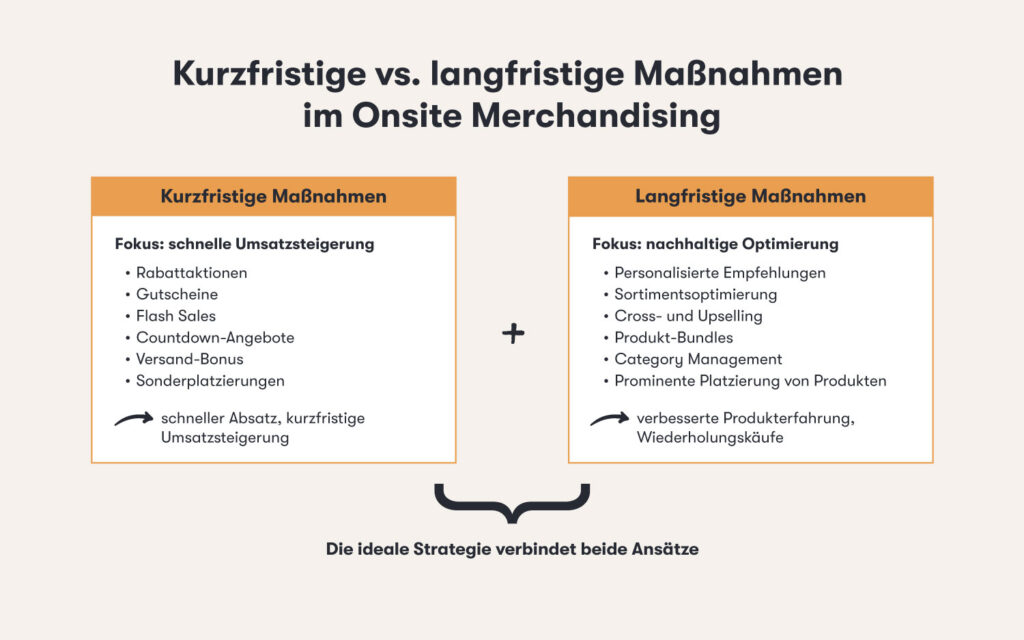
Comparison of short-term and long-term measures in onsite merchandising: comparison of focus points, examples, and goals (source: own representation)
Now that we have clarified the basics and objectives of onsite merchandising, let's dive deeper into e-commerce strategy. What specific onsite measures are available to e-commerce shops, and how can they be used in a targeted manner?
There are numerous touchpoints in the online shop where onsite merchandising becomes visible and actively supports the digital customer journey: from the home page to product overview and detail pages to the shopping cart and checkout. Below, we take a closer look at the most important touchpoints and typical measures.
Love at first click? The home page is the most important entry point and therefore fundamental to your onsite merchandising. It shapes your customers' first impression and determines the rest of their customer journey. In our guide, you can read about how to design the perfect home page for your online shop.
Your customers can quickly find their way around on the home page. Here you can clearly display your product categories, highlight bestsellers, prominently place sale items, or present new products. For returning customers, a recommendation system can also be used to display individual product recommendations, e.g., items that are regularly repurchased (drugstore products, pet food, etc.).
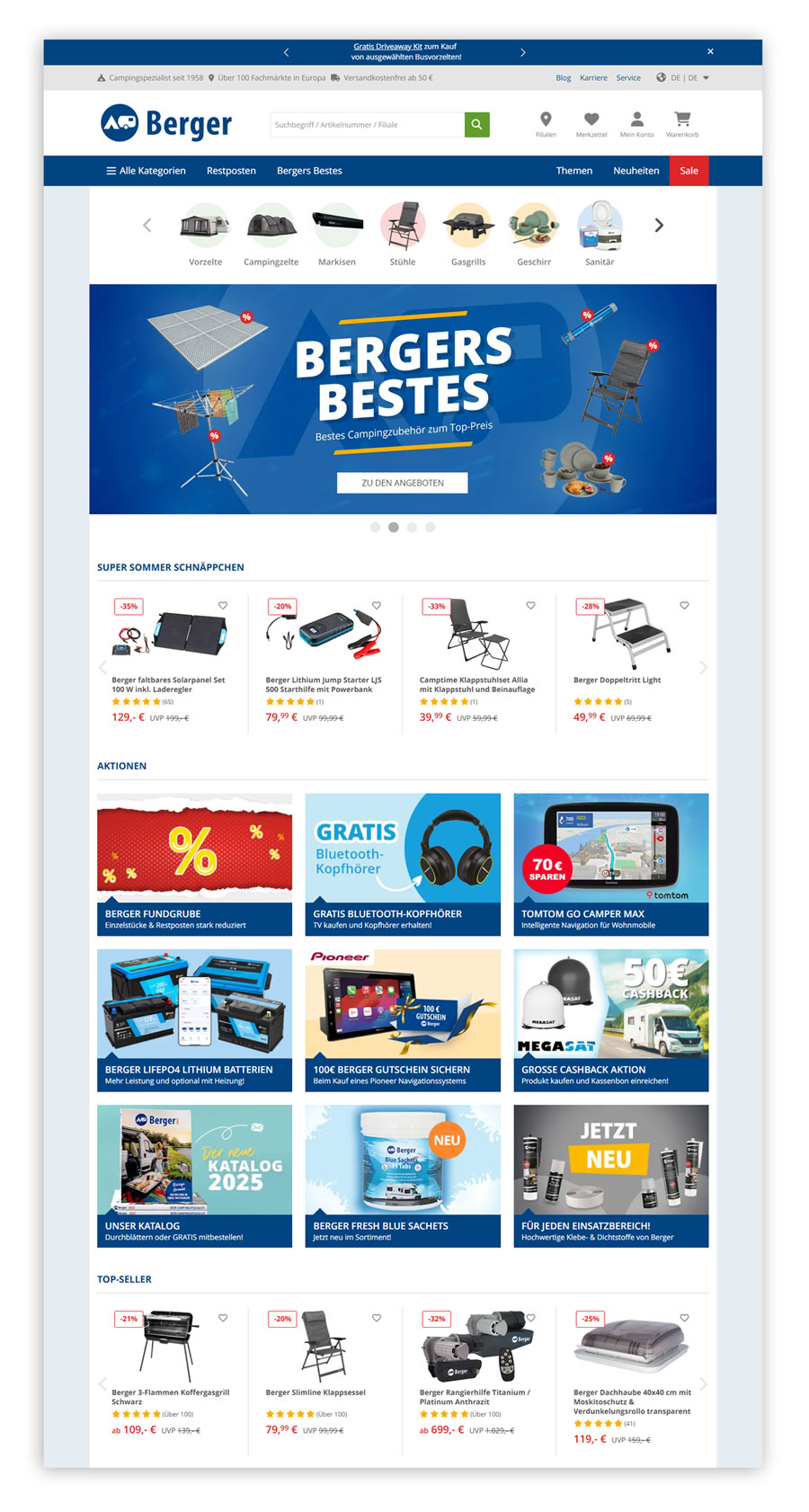
Important categories, top-selling products, and current sale items are prominently displayed on the Fritz Berger online shop homepage
(Source: Screenshot from fritz-berger.de)
When it comes to product listing pages (PLPs), there are two types: category pages and search results pages. Both serve the key function of presenting customers with suitable products, either through navigation or search.
Category pages support targeted browsing within a product range, while search results pages serve a specific search intention. The targeted optimization of search results pages as part of onsite merchandising is also known as searchandising. Despite the different starting points, many onsite merchandising measures can be applied to both types of pages.
For example, you can prioritize certain brands or items in the results list to bring them more into focus. It is also effective to integrate banners as tiles in the product list or above the results to highlight specific products, promotions, or topics. These banners link directly to specific products or product groups and thus serve as targeted product presentations. In addition, you can control the sorting according to criteria such as popularity, new arrivals, availability, or margin to quickly guide customers to the most relevant offers.
The more intelligent and relevant the results display is, the more satisfied customers will be. This reduces the bounce rate and increases the likelihood of a purchase.

Ensure a consistent shopping experience
Whether you are optimizing category or search results pages, it is important that your customers always have a consistent and personalized shopping experience. Even though different teams are often responsible for optimizing both types of pages, the user experience should be consistent—regardless of whether your customers arrive at a product listing page via onsite search or the navigation structure.
Product detail pages (PDPs) are fundamental to your onsite merchandising, as they are usually the last touchpoint before the ordering process. Measures such as the following are suitable here:
On a PDP, you can communicate valuable information about the product, payment, and shipping, optimize the experience with artificial intelligence, and create shopping incentives such as promotions and discounts with striking visuals.
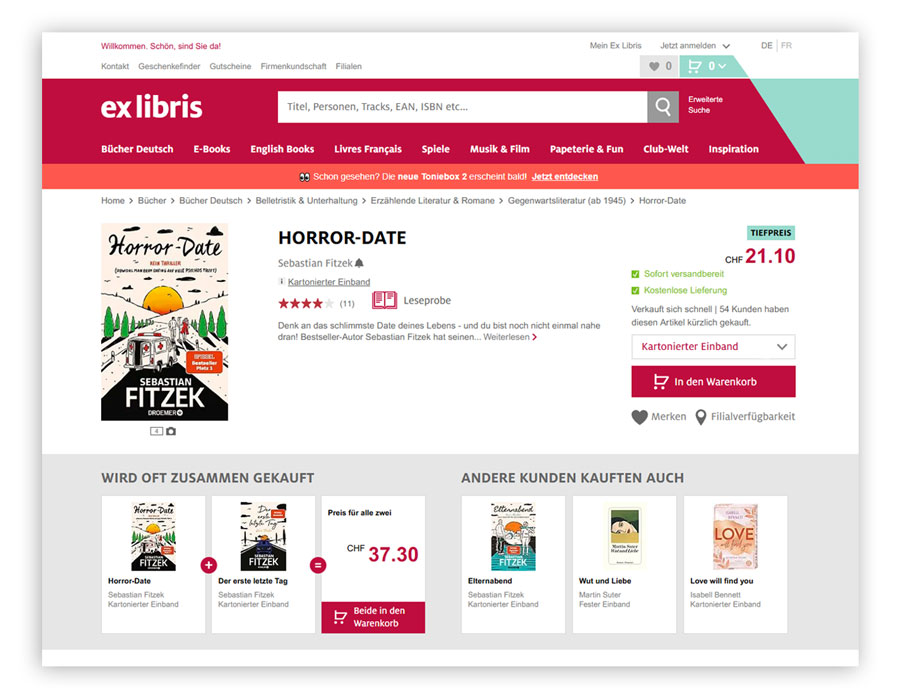
The product detail page in the Ex Libris online shop displays bundle offers, product recommendations, sales figures, product reviews, product images, and more.
(Source: Screenshot from exlibris.ch)
Campaign or theme landing pages are a key tool in onsite merchandising for showcasing products in a targeted manner. They offer the opportunity to present promotions, new products, or bestsellers in a clear and curated way.
Examples of merchandising measures on such sites:
This approach directs traffic straight to relevant products, guides the shopping experience, and actively supports the purchasing process—all in line with onsite merchandising.
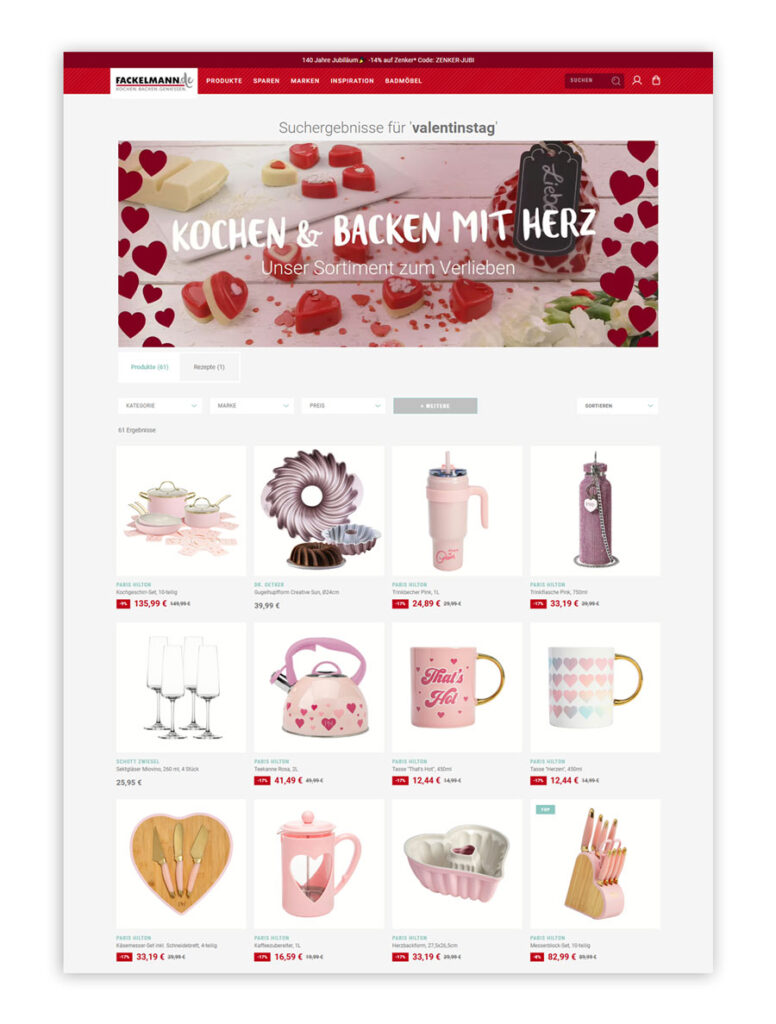
On the Valentine's Day theme page in the Fackelmann online shop, customers will find a curated product list with matching items and a banner above the results list
(Source: Screenshot from fackelmann.de)
In the shopping cart and checkout, the focus is primarily on trust-building elements such as delivery information, reviews from satisfied customers, return policies, and the various payment methods. You should also point out minimum order values for free shipping. This makes it easier for your visitors to complete their purchase.
At the same time, there are opportunities to increase the value of the shopping cart, e.g., through complementary products (cross-selling) and attractive bundles that motivate customers to buy more.
To ensure that onsite merchandising is not just static but truly effective, intelligent control is required. Instead of showing all visitors the same products or placements, content can be dynamically adapted using rule logic and targeting —for example, according to inventory, margin, user behavior, or target group affiliation.
This turns a simple product recommendation into a tailored display that simultaneously supports the company's goals (e.g., selling off remaining stock or focusing on high-margin items) and offers customers a more relevant shopping experience.
Rule logic allows you to control your onsite merchandising efficiently and automatically. Instead of moving products manually, you define fixed criteria according to which items are prioritized and displayed.
This ensures that your most important products are always visible at the right time—regardless of whether you want to sell off stock, promote new products, or highlight high-margin items.
Stay up to date on personalization: Sign up for the Epoq newsletter. Register now!
While rule-based logic primarily works on the basis of product range or time, targeting ensures that content, products, and placements in the online shop are displayed to the right customers at the right time. You can proceed at different levels of granularity—from product-based approaches to 1:1 personalization in real time.
Individual products, brands, or categories can be highlighted specifically for those customers who are identified as particularly relevant based on their click and purchase behavior. Example: A new book release is preferentially displayed to users who have already purchased similar titles—whether on the home page, in the results lists, or via cross-selling on the product detail page.
Segment-based targeting is aimed at groups with similar interests or behavior patterns, such as "outdoor enthusiasts" or "frequent buyers of drugstore items." In onsite merchandising, this means that bestsellers or high-margin products can be prioritized for these segments, displayed higher up in the results list, or highlighted on the home page using targeted modules.
The highest level of targeting is 1:1 personalization. From the very first click, product recommendations, sorting, or promotions can be dynamically adjusted in real time —even without an existing profile. For returning customers, previous purchases and interactions are taken into account, so that the entire product presentation is tailored even more precisely to individual needs. The result: a customized shopping experience that increases sales potential and boosts customer value in the long term.
Successful onsite merchandising only works when the interests of the customer and the goals of the shop are aligned. Products, banners, or promotions should be placed and prioritized in such a way that they encourage the purchase decision without appearing intrusive.
This means that while you, as a shop operator, want to promote specific brands or highlight certain items, the shopping experience for the customer should remain natural, relevant, and inspiring. Dynamic recommendations, prioritized products in results lists, or targeted campaign landing pages should fit harmoniously into the customer journey. This creates a win-win situation: the customer finds suitable products quickly and feels well advised, while at the same time supporting corporate goals such as increasing sales, selling off stock, or focusing on margins.
With the right adjustments, your online shop will become a sales pro. Keep the following four questions in mind to put your onsite merchandising on the road to success.
When you take these aspects into account, you create a shopping experience that appeals to customers, builds trust, and facilitates purchasing decisions. The result: higher shopping cart values, more repeat purchases, and a sustainably increased conversion rate.
The four key questions serve as a strategic framework for your onsite merchandising. They can be used for both short-term campaigns and long-term optimizations. In the table, we show suitable examples for both perspectives for each question.
As a central discipline in e-commerce, onsite merchandising supports your sales strategy by presenting products in a targeted manner at the right touchpoints – from the home page to product overview and detail pages to campaign landing pages and the shopping cart. Both short-term impulses and long-term optimizations can be used in a targeted manner. The key is to integrate the individual measures seamlessly and unobtrusively. The more harmoniously they fit in, the better they complement the user experience. Through the targeted control of prioritization, personalization, placement, and staging, both corporate goals and customer needs can be optimally served. This creates a classic win-win situation: while you, as a shop operator, effectively implement your sales strategy and increase your conversion rate, your customers enjoy a smooth and pleasant shopping experience.
The home page, detailed product overview pages, and product detail pages are just as suitable for onsite merchandising as campaign landing pages, the shopping cart, and the checkout page. All of these areas have a significant influence on the purchase decision.
Targeted placement of high-margin items, promotions, or individual product recommendations create relevance, draw attention, and encourage purchases—which can significantly increase conversion rates. They also promote additional orders, which increase the value of the shopping cart.
Personalization ensures that products, banners, and promotions are tailored precisely to each individual visitor—based on behavior, purchase history, or segment affiliation. This makes every touchpoint relevant: recommendations, prioritized items in results lists, or special campaign content precisely match the user's interests. This increases the likelihood of a purchase, raises the value of the shopping cart, and strengthens customer loyalty in the long term.
Yes, onsite merchandising has nothing to do with the size of an online store. Even in small stores, it is essential to present products in the best possible way and market them efficiently. This allows retailers to increase sales per visitor.
You can measure success using KPIs such as conversion rate, average shopping cart value, click-through rate, and abandonment rate. Tools such as Optimizely and Google Analytics, as well as A/B testing and heat maps, can help you with this.
Want to delve deeper into the topic of personalized product recommendations?
Then download our recommendation system Guide!

You are currently viewing placeholder content from HubSpot Embedded Content. To access the actual content, click the button below. Please note that doing so will result in data being shared with third-party providers.
More InformationYou are currently viewing placeholder content from HubSpot. To access the actual content, click the button below. Please note that doing so will result in data being shared with third-party providers.
More InformationYou are currently viewing placeholder content from HubSpot Meetings. To access the actual content, click the button below. Please note that doing so will result in data being shared with third-party providers.
More Information