
E-book – Personalization in E-commerce
In this e-book, you will learn why personalization is important in e-commerce and what the term personalization actually means.

Conversion optimization aims to get visitors to perform a specific action. In e-commerce, it's not just traffic that counts, but above all whether users interact with content, fill out a form, or make a purchase. The better the conversion is optimized, the more you get out of your website traffic. User centricity is crucial for this. If you understand your target group and offer them a compelling experience, you will increase your conversion rate in the long term. In this article, you will learn what conversion optimization entails, how you can increase it step by step with specific measures, and what you should pay attention to in the process.

Here's what you can expect to find in this blog article:
What exactly does conversion optimization mean?
What options are available for optimizing conversion?
Technology and usability
Layout and design
Content and communication
Offers and promotions
How does AI personalization help with conversion optimization?
Orientation through ecommerce search engine
Advice via the AI Shopping Assistant
Inspiration through product recommendations
Connection through email personalization
Central knowledge base for effective personalization
How does conversion optimization work in practice?
Precise analysis instead of gut feeling
Look ahead instead of reacting
Test faster, scale better
Dynamic campaign management
How to avoid the 5 most common conversion optimization mistakes
Whether engagement, lead, or purchase, conversion rate optimization (CRO) encompasses all measures that shop operators use to encourage their visitors to take a desired action. Conversion rate optimization should not be confused with usability optimization, which improves the general user-friendliness of a website.
In e-commerce, conversion optimization focuses specifically on behavior related to clearly defined business goals. A distinction is made here between macro and micro conversions:
Accordingly, conversion optimization can encompass various goals —from newsletter sign-ups, creating a customer account, or activating a "back-in-stock" alert (micro) to completing a membership or successfully checking out (macro).
Stay up to date on personalization: Sign up for the Epoq newsletter. Register now!
By optimizing conversion, you can turn visitors into customers and thereby increase your measurable business success. But what options are available? Below, we present the four key areas that are particularly important for conversion optimization.
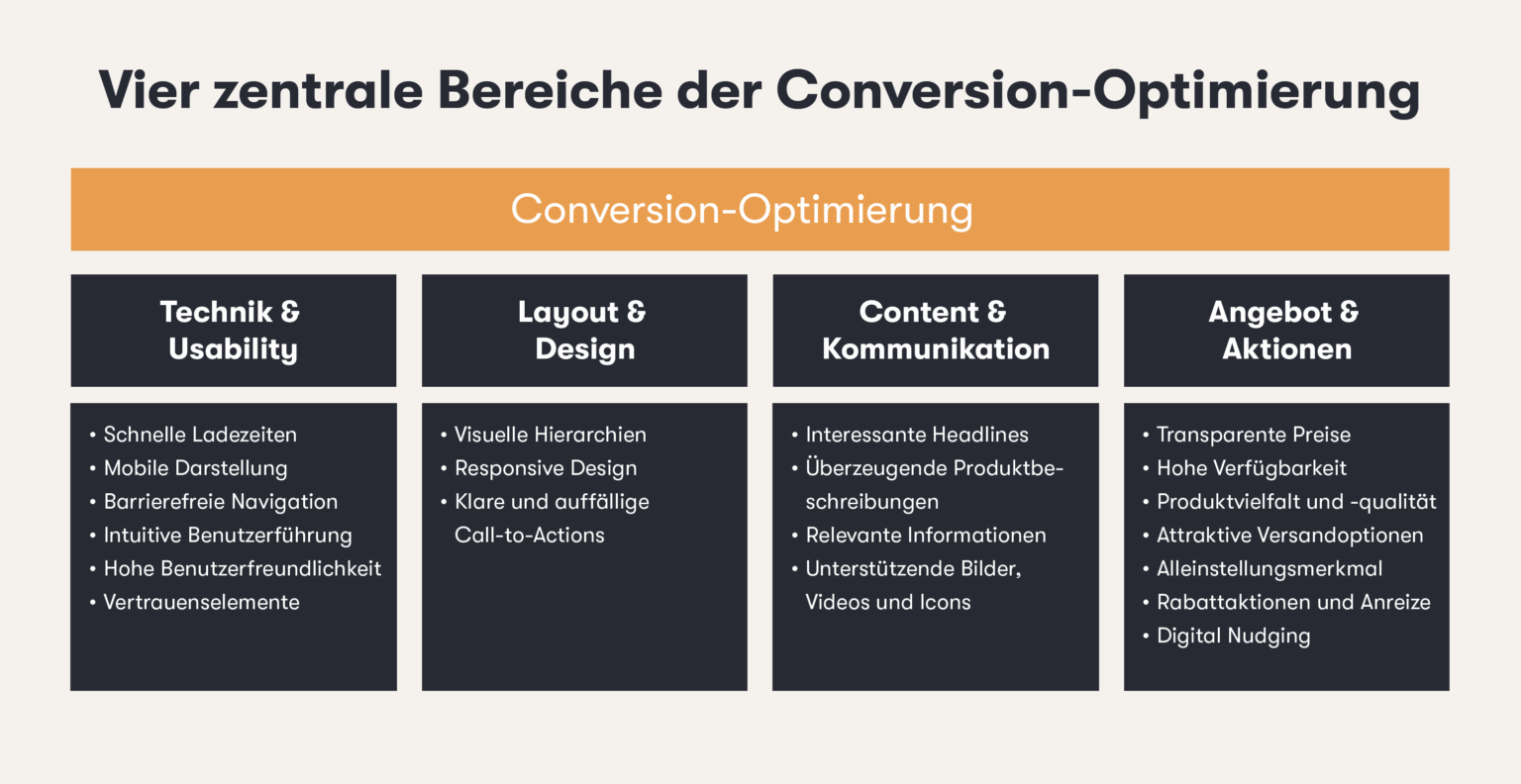
The four pillars of conversion optimization offer numerous approaches for increasing business success. (Source: Own representation)
A solid technical foundation is crucial for a good conversion rate: fast loading times, optimized mobile display, and barrier-freenavigation ensure that visitors can navigate the shop smoothly. User guidance should be clear and intuitive and enable simple interactions.
User-friendliness also plays a key role: a powerful search function helps your customers quickly find the product they want, while well-placed buttons, clear menus, and easy-to-follow processes make navigation easier. Trust elements such as seals of approval, secure payment methods, and transparent data protection information round off the user experience and strengthen the willingness to buy.
Well-thought-out layouts and visual hierarchies guide your users logically through the online shop and purchasing process. Breadcrumbs, progress indicators, and clear product information increase interaction depth and dwell time and reduce bounce rates. A responsive design also ensures a consistent user experience across all devices.
Another essential visual element of conversion optimization is the call-to-action (CTA). You have a lot of freedom in terms of design here—from the position and color to the size and text. However, it is important that CTAs stand out and trigger an impulse to act.
With targeted content, you can significantly influence the purchase decision and thus increase the conversion rate. This includes interesting headlines, compelling product descriptions, and relevant information about shipping, returns, and payment, which build trust and facilitate purchase decisions.
Images, videos, and icons also help users better understand your offering. This allows you to accurately communicate the added value of your products and services —with an emotional or rational focus, depending on your target audience.
An attractive overall package increases conversion: transparent prices, high availability, product variety and quality, and attractive shipping options are crucial. Also communicate the customer benefits and your unique selling point to convince customers.
Discount campaigns and other incentives are a very targeted way to promote conversion optimization. One proven measure that often works subconsciously and discreetly increases the conversion rate is called digital nudging. This refers to psychological stimuli that you can use to subtly guide your users toward a decision. Typical examples are scarcity ("Only 2 left in stock") and social proof ("Already purchased 10 times today" or "Popular with customers like you").

Tip
Whether it's content, design, technology, or offers, many elements in an online shop affect micro-conversions by encouraging users to interact. Keep an eye on these small but crucial user actions to identify and optimize weak points along the customer journey. This ensures that even minimal interactions support the path to the final conversion.
The four pillars mentioned above form the foundation of conversion optimization. However, it becomes even more effective when you useAI-powered personalization as an overarching strategy to create individually relevant experiences. This allows you to analyze in real time how users behave and what they are interested in. This data enables you to tailor the layout, content, and product selection to each individual shop visitor, thereby improving the digital customer experience. This, in turn, significantly increases the likelihood of a conversion.
Below, we show you selected measures that you can use to support conversion optimization through a tailored, seamless approach throughout the entire customer journey.
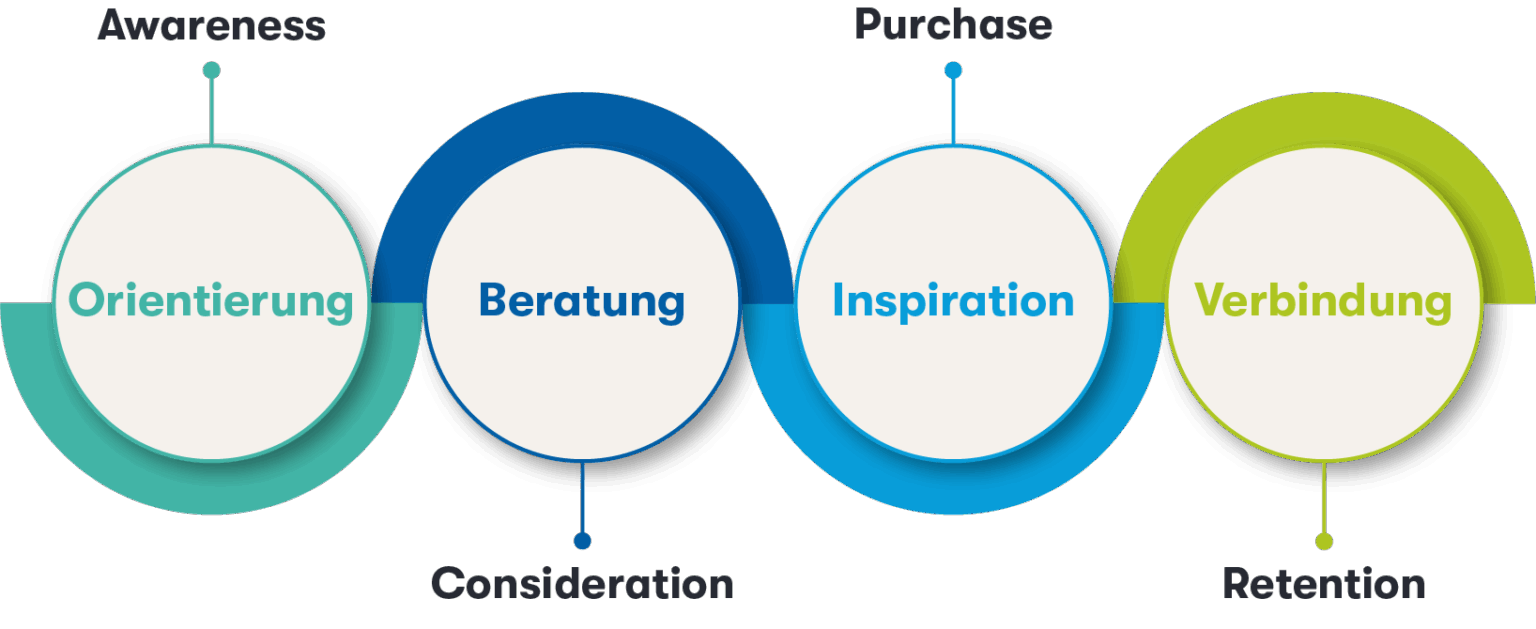
AI-supported personalization along the customer journey contributes significantly to conversion optimization. (Source: Own representation)
An ecommerce search engine adapts results and suggestions to the previous behavior and interests of users. This means that relevant products are displayed instead of a generic list of results. In addition, functions such as individualized sorting or visual cues, such as banners in the search function's typeahead or on results pages, provide additional guidance and increase the relevance of the search results. This leads to a lower bounce rate in the shop and thus has a positive effect on the conversion rate.
The AI Shopping Assistant offers personalized advice, product suggestions, and targeted user engagement in an interactive dialogue format. It recognizes intentions in real time and responds with tailored recommendations, answers frequently asked questions, or assists in filtering product selections. Individualized and targeted digital advice enables customers to make informed purchasing decisions, resulting in fewer returns. This, in turn, has a positive effect on the conversion rate.
Personalized product recommendations are based on previous browsing behavior, past purchases, or similarities to other users. They appear at relevant touchpoints such as in the shopping cart, on the home page, or on product detail pages. In addition, content recommendations such as blog articles, guides, or product comparisons can reinforce the impulse to buy, as they support the decision-making process. This increases the average shopping cart value, which is ultimately reflected in an improved conversion rate.
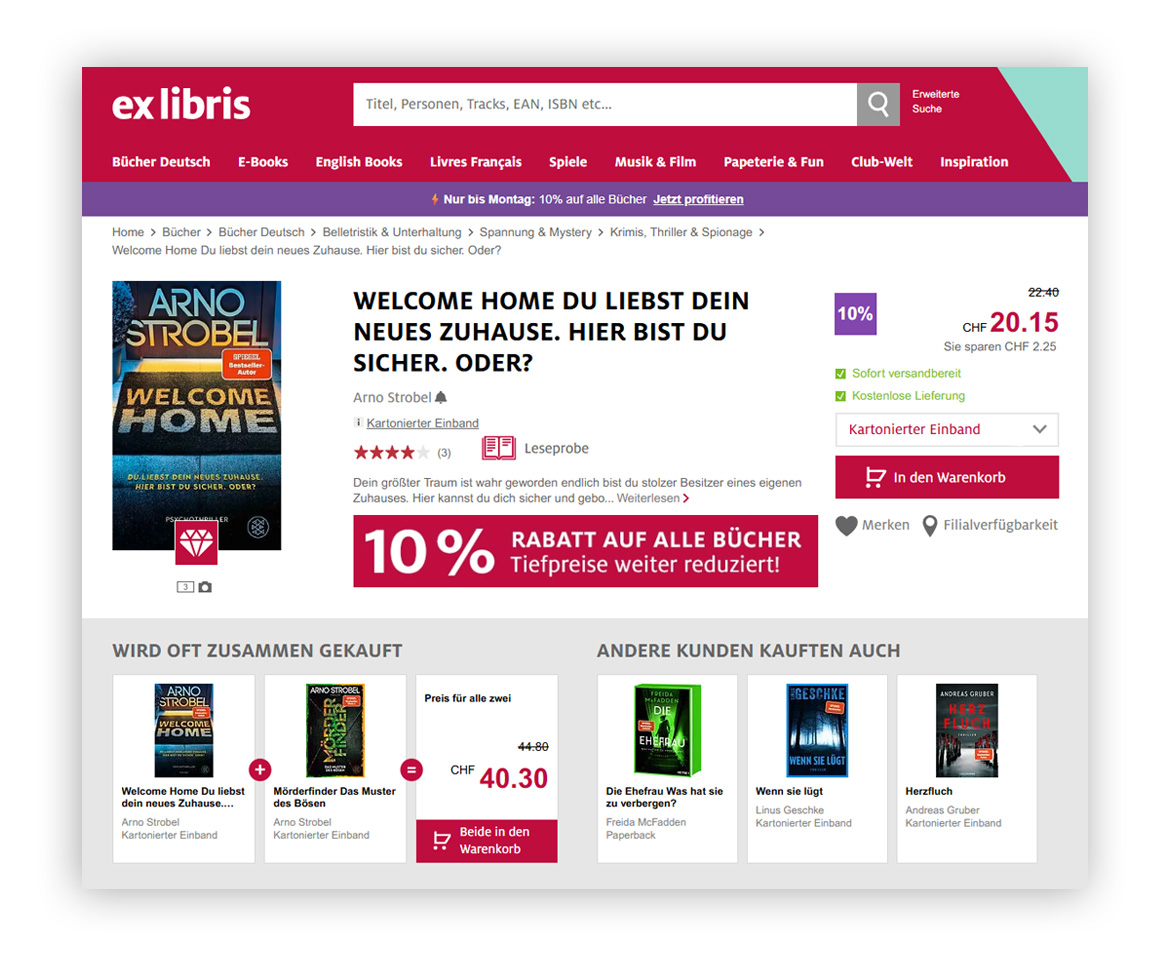
Ex Libris presents matching bundle recommendations on its product detail pages. (Source: Screenshot from exlibris.ch)
Email personalization tailors subject lines, content, and offers in newsletters or triggered emails to individual interests, abandoned carts, or past purchases. This helps maintain the connection and increases the likelihood of a repeat purchase. Thanks to AI-powered analytics, it’s also possible to determine, based on the product, which recipients are most likely to be interested in it. This ensures that only those customers for whom the offer is actually relevant receive an email with the corresponding product recommendation (such as a new book release). Overall, email personalization leads to higher click-through rates and increased traffic to the store, which ultimately boosts the conversion rate.
Relevance as a decisive factor for success
For online shops, it is particularly important to increase traffic, improve visitor retention, prevent bounce rates, reduce returns, and increase shopping cart value. That is why AI-supported personalization is increasingly becoming a decisive conversion lever. After all, the more relevant the content, the higher the engagement and conversion rates and the lower the return rate.
An intelligent knowledge base forms the foundation for true 1:1 personalization throughout the entiredigital customer journey. It links product data, user behavior such as click and purchase history, domain knowledge, external data sources, and information from LLM technologies. Using advanced algorithms, including machine learning and reinforcement learning, this data is processed into usable knowledge.
The knowledge base continuously learns with each interaction. This allows it to be used by multiple personalization solutions simultaneously, so that the services learn from each other and knowledge does not remain in isolated silos.
On this basis, precise recommendations can be derived, content can be customized, and relevant touchpoints can be personalized. The knowledge base can be used flexibly: either comprehensively across all phases or modularly for individual areas. This creates a seamless, individually tailored user experience that can specifically increase conversion.
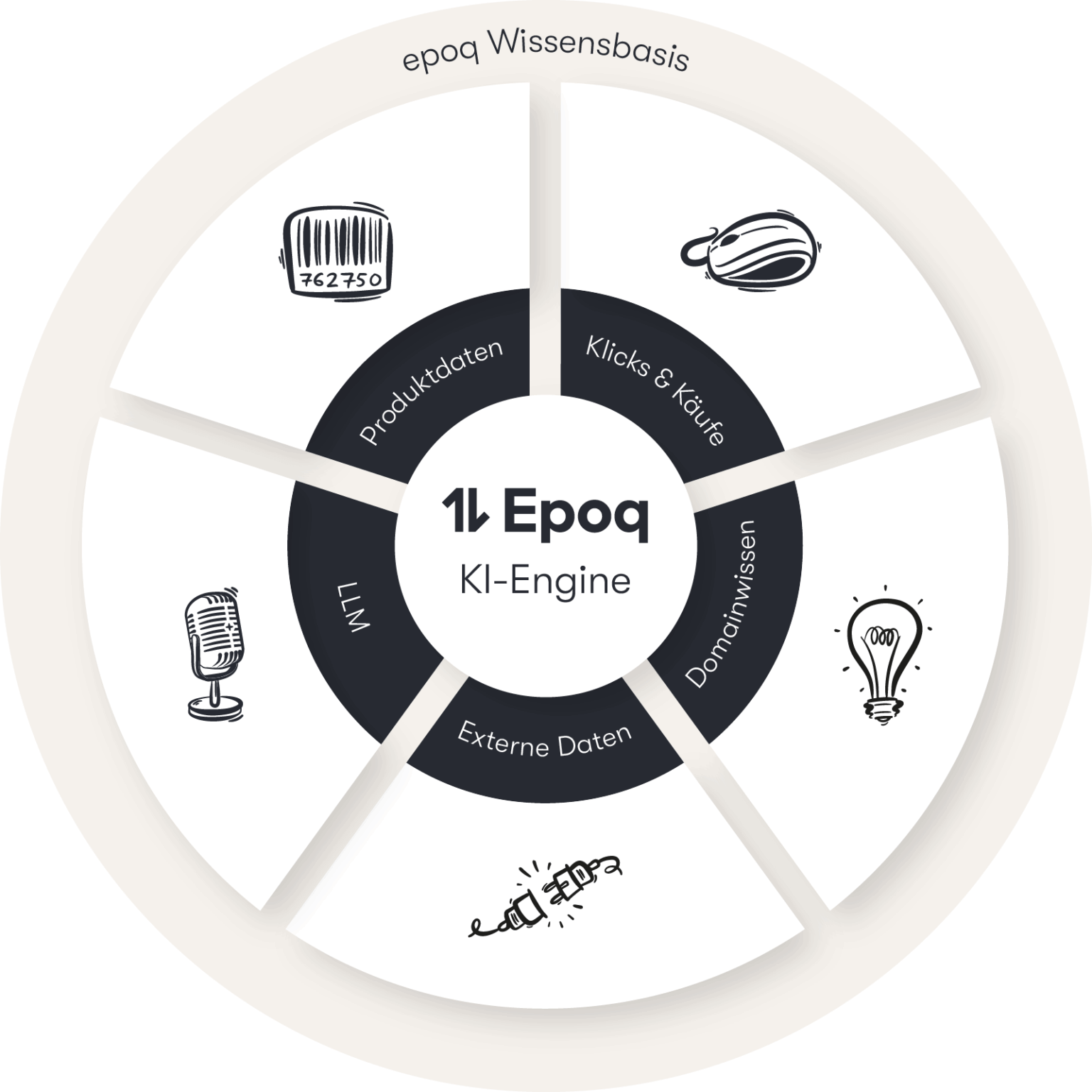
In the knowledge base, data and information are linked by intelligent algorithms to form valuable knowledge. (Source: Own representation)
Effective conversion optimization is based on data, testing, and proactive action. With modern, AI-powered tools, you have completely new opportunities to improve your online store in a targeted, efficient, and scalable way.
Automated data analysis allows you to reliably identify user behavior, patterns, and weak points in the conversion funnel. This gives you a clear picture of where your visitors are leaving and where you should focus your optimization efforts. With the help of AI, you can design scalable and continuously learning conversion optimization processes.
Predictive models enable you to forecast future user behavior. This allows you to not only react, but also take action in important situations with appropriate triggers such as pop-ups, discounts, or notifications to prevent potential abandoned purchases and save conversions.
AI-supported A/B testing allows you to automatically run variants against each other, quickly and effectively identifying the best solutions for your e-commerce business. This shortens the testing cycle and allows you to interpret results based on objective data. The result? More conversion optimization with less effort.
Stay up to date on personalization: Sign up for the Epoq newsletter. Register now!
Marketing campaigns also benefit from AI. This is because it allows you to automatically adjust target groups, ad motifs, and budgets while monitoring conversions in real time, immediately identifying anomalies, and continuously optimizing your campaigns.
Conversion optimization is not a matter of chance—it only works if you use data, act proactively, personalize, and employ intelligent tools. This is how you can increase the efficiency of your online store in the long term.
Pay attention to these points to avoid the most common pitfalls:
According to a recent GfK survey¹, a secure payment process is the most important criterion in e-commerce for 62 percent of respondents. In addition, the payment process should be simple (46 percent) and fast (37 percent). Specifically, 27 percent believe that card payments should require as few clicks and data entries as possible. The representative consumer survey commissioned by Mastercard also revealed that 39 percent of respondents do not want to create a customer account. And 36 percent consider it critical if they have to provide too much personal information when making online payments.
Shop operators can incorporate relevant survey results such as these into their optimization strategies. Such data provides valuable insights into which aspects are particularly important from the customer's perspective and should therefore be prioritized on a sound basis in order to make the purchasing process as smooth and trustworthy as possible.
A high conversion rate is the result of targeted measures along the entire customer journey—from technology and layout to content and offers. Personalization is particularly effective: if you offer your users relevant content, suitable products, intelligent guidance, and individual advice, not only will their satisfaction increase, but so will their willingness to buy and their brand loyalty. Modern technologies such as AI, A/B testing, and automated analytics enable data-driven, scalable implementation. Those who understand their users and offer them the right thing at the right time can turn traffic into measurable business success.
Source: ¹ Consumer survey conducted by GfK on behalf of Mastercard
This refers to all measures taken to specifically increase the conversion rate in an online shop – divided into macro and micro conversions. The measures aim to improve the path to conversion. This is achieved by identifying and improving specific areas for improvement along the entire customer journey.
Depending on the industry, a "good" conversion rate is often between 1% and 3%, sometimes significantly higher.
You can increase your conversion rate by optimizing the user experience throughout the entire customer journey—for example, through personalization, improved search, high-quality product pages, and secure payment methods. A KPI-based approach shows which measures achieve which effects.
It is a key KPI in online retail: a higher conversion rate means more sales with the same amount of traffic.
Personalization is crucial for conversion optimization because it offers each user a shopping experience tailored to their interests, behavior, and needs. Relevant content, product recommendations, and offers increase the likelihood that a visitor will perform a desired action.
Want to delve deeper into the topic of personalization in e-commerce?
Then download our e-book now!

You are currently viewing placeholder content from HubSpot Embedded Content. To access the actual content, click the button below. Please note that doing so will result in data being shared with third-party providers.
More InformationYou are currently viewing placeholder content from HubSpot. To access the actual content, click the button below. Please note that doing so will result in data being shared with third-party providers.
More InformationYou are currently viewing placeholder content from HubSpot Meetings. To access the actual content, click the button below. Please note that doing so will result in data being shared with third-party providers.
More Information